

Global businesses have come a long way in digitizing operations: finance, HR, marketing, and customer support now run on globally unified platforms. But one essential system still lags behind: the voice layer—the most fundamental channel for sales, support, and executive communication—remains fragmented across countries.
Despite cloud collaboration and global connectivity, many enterprises still rely on geographically-bound telephony. This includes multiple regional carriers, separate contracts, inconsistent SLAs, varying quality standards, and complex compliance requirements. It’s a model designed for another era, and it’s starting to limit how fast multinational teams can scale.
Recent industry discussions have highlighted this mismatch between how modern enterprises operate and how their global voice systems are built. And we agree.
But the answer is not just a single global switch. The real opportunity lies in creating regionally intelligent, globally unified voice infrastructure that balances global consistency with local presence, compliance, and trust.
This is where cloud-native providers like Global Call Forwarding are redefining global telephony.
The Telephony Bottleneck in a Global Business Landscape
The global economy runs on instant, borderless communication. Yet traditional telecom frameworks are still built around national boundaries and physical infrastructure. Add to this, much-needed country-specific regulations and compliance designed to eliminate fraudulent activity and infrastructure limitations in developing countries and remote, hard-to-reach regions.
The global cloud telephony services market is expected to grow from $31.9 billion in 2024 to $68.02 billion in 2029, driven by cloud adoption and the need for virtual international phone numbers and flexible global communication solutions. A majority of companies (75% in this study) across verticals like ITeS, education, retail, healthcare, BFSI, etc., are in the midst of adopting unified communication platforms to bring digital transformation across business operations by 2030.
We also see this upwards trend in demand for UCaaS (market size estimated to reach $262.37 billion by 2030), BYOD, and BYOC phone solutions in our interactions with customers across different industries and regions.
These trends point to one truth: businesses want a unified communication framework that scales globally, without the friction of managing carriers country by country.
However, many enterprises are still managing:
- Separate providers per region or country
- Complex, region-specific compliance requirements
- Inconsistent SLAs, support, and provisioning timelines
- Routing rules that don’t align with how their teams, customers, or data actually operate
- Fragmented visibility into performance and costs
Half of multinational global business service organizations plan to expand their geographic footprint, with many citing connectivity and operational complexity as key barriers to growth.
So, scaling successfully globally now depends on how well enterprises unify their communications stack.
Why Businesses Need Regionally Intelligent Global Voice
For years, the answer seemed simple—centralize communication with one carrier. But that approach often trades flexibility for control. Traditional telcos still operate on legacy frameworks that are slow to adapt, costly to scale, and limited in regional insight.
A new generation of modern global telephony providers, however, is taking a software-defined, integration-focused, regionally intelligent approach—one that brings flexibility while connecting local and global layers seamlessly.
Here’s how we are thinking about the future of regionally intelligent global voice:
1. Centralized Control, Local Precision
A global enterprise needs visibility across every market but can’t afford to lose the familiarity and trust that come with local presence.
Global operations demand:
- A single platform for phone numbers, advanced routing, reliable and secure call quality, advanced analytics, and transparent billing
- Consistent standards for quality, uptime, and incident response
- The ability to adapt quickly when you enter new markets, shift your support model, or restructure a region
But calls are local experiences. Customers care that numbers look familiar, that calls connect quickly, that caller IDs are trusted, and that businesses comply with in-country regulations.
That’s why our global coverage, Local 2-Way Voice, and advanced regional routing capabilities enable businesses to:
- Make and receive calls with the same business phone number, no matter the location of your teams
- Stay compliant with in-country regulations and KYC requirements
- Present local caller IDs that increase answer rates and customer trust
- Manage all inbound and outbound phone lines through a single, centralized platform
This approach bridges two worlds: global scalability and local authenticity.
2. Reliable Global Infrastructure
Every enterprise expansion depends on trust—in the network, in the uptime, and in the partner behind it.
For us, how modern global voice should work is clear:
- Direct relationships with Tier-1 carriers and regional partners, enabling wide reliable global coverage
- Global and regional Points of Presence (PoPs), ensuring reliable call quality and minimal latency
- Built-in voice redundancy and intelligent failover to maintain continuity when individual routes or regions fail.
We have built our global voice network with these core principles in place.
On top of this, our IT and tech teams are constantly testing and monitoring global call traffic and performance as well as evaluating potential threats to our infrastructure. These teams are distributed across multiple regions to meet and support our customers where they are.
By combining Tier-1 connectivity with intelligent routing and local carrier relationships, businesses gain both the global reach and the regional performance they need to support mission-critical operations.
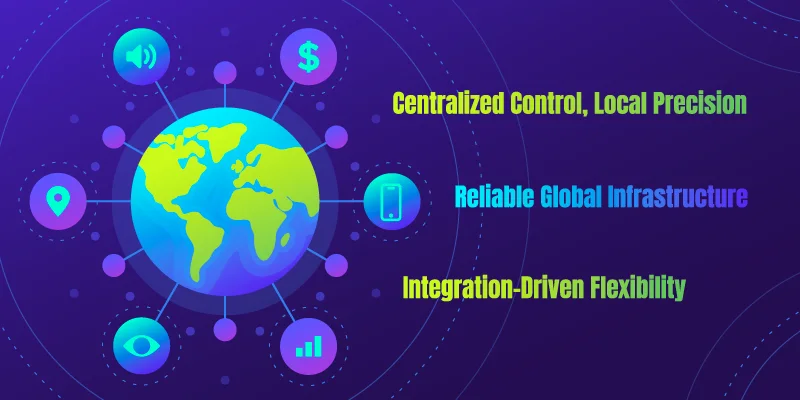
3. Integration-Driven Flexibility
Today’s communication stack isn’t built around one platform—it’s an ecosystem. Businesses use CRMs like Salesforce, HubSpot, and Zoho; helpdesks like Zendesk and Intercom; and collaboration tools like Microsoft Teams and CCaaS tools like Genesys.
Through SIP Integrations and BYOC phone solutions, Global Call Forwarding connects directly into these systems—enabling businesses to:
- Extend global voice coverage across existing apps and workflows
- Enable external and global 2-way calling within your existing systems
- Log, record, and analyze calls with AI-driven insights
- Maintain consistent routing and reporting across every region.
This flexibility allows IT and operations teams to scale without overhauling infrastructure.
We have a variety of voice and SIP integrations to support businesses across different industries and functions.
How Global Call Forwarding Achieves Regional Expertise
Scaling across 160+ countries means navigating diverse regulatory environments, each with its own number types, documentation standards, and compliance rules.
This is where Global Call Forwarding’s regional expertise provides a critical advantage. Our teams work directly with local carriers and regulators to ensure:
- Extensive global phone number coverage
- Smooth number provisioning and activation
- Compliance with local KYC requirements and laws
- Access to reliable in-country routing that improves uptime and call quality.
Our global communication experts keep themselves updated on every new in-country regulation or compliance requirement, and we educate our customers on best practices immediately to avoid any disruptions.
From the GCC and APAC to LATAM and Europe, this mix of local knowledge and global consistency helps enterprises launch faster, serve better, and stay compliant everywhere they operate.
Many global organizations have already applied this model to streamline their communications. Read how our customers use Global Call Forwarding to support international growth and scale with confidence.
Rethinking “Borderless Communication”
The next phase of global communication isn’t just about unifying telephony. It’s about building a communication system that is intelligent, adaptive, and region-aware. Global enterprises today need a model that reflects how they actually work: centralized where it matters, localized where it counts.
That’s the foundation of Global Call Forwarding’s approach to regionally intelligent global voice. We’re here to help businesses expand without compromising compliance, quality, or customer experience.
As global networks evolve, the question isn’t how to connect but how to connect smarter and reliably. The future of voice belongs to enterprises that treat every market as local and every connection as global.
If your teams are still wrestling with fragmented carriers, uneven call quality, or compliance uncertainty, let us help! Chat with our experts to explore the right global voice strategy for your regions and use cases.
