

Webex Calling is one of the most capable unified communications platforms an enterprise can run, and the broader UCaaS market it belongs to is projected to reach $404.25 billion by 2033. For large organizations, though, the collaboration layer is only half the equation. The other half is the Public Switched Telephone Network (PSTN) that carries real calls to real customers in every market, and that is where bundled options start to show their limits.
These standard, out-of-the-box carrier bundles typically package:
- Fixed Minutes: A rigid allotment of domestic (and occasionally international) calling minutes per user.
- Basic Number Provisioning: A standard Direct Inward Dialing (DID) phone number and basic emergency routing.
- Standard Features: Basic cloud routing like voicemail-to-email and standard call forwarding.
For a business operating in a handful of countries, Cisco’s native calling plans work well. For a multinational enterprise with offices, customers, and regulatory obligations across dozens of markets, relying on one bundled PSTN source can create gaps in coverage, slow provisioning, documentation hurdles, and uneven number availability.
That is why many enterprises separate the telephony carrier layer from the UC platform through Bring Your Own Carrier (BYOC). In this guide, we’ll cover:
- What Webex BYOC is
- Decoupling PSTN from UC platforms
- Challenges of native Webex calling options
- How BYOC extends global Webex calling
Key Takeaways
- Large enterprises often separate PSTN from UC platforms
- Webex remains the collaboration layer
- BYOC adds flexibility, scale, and global reach
- Best-fit strategy often combines Webex + specialized global carrier
What Is Webex BYOC?
Webex BYOC (Bring Your Own Carrier) is a flexible telephony solution that lets an organization connect Webex Calling to an external voice carrier instead of buying PSTN service directly from Cisco.
Webex remains as the platform your teams use to call, meet, message, and collaborate, while a separate voice carrier supplies the phone numbers, routing, and in-country connectivity underneath it. The 2 layers work together, but they no longer have to come from the same vendor.
Webex Calling can connect to the phone network (the PSTN) in a few ways. With Cisco Calling Plans, Cisco is your carrier in a bundled package, and Cisco also supports bringing an outside carrier through its certified programs.
There’s also a simpler option that needs none of that setup: Keep your Webex number and forward calls from international numbers you buy elsewhere into Webex. That’s the approach we’ll focus on here, since it’s the easiest way to add global coverage without changing how Webex is set up.
Both CCP and Local Gateway are BYOC paths, and many enterprises use SIP Trunking to route their chosen carrier’s numbers into Webex. Everything stays managed centrally in the Webex Control Hub.
Why BYOC Matters for Enterprise IT Teams
For enterprise IT, BYOC comes down to control. Bundled plans tie coverage, pricing, and number availability to a single vendor’s footprint, so a gap in that footprint becomes your gap too. BYOC lets teams choose the phone carrier that performs best in each region, add markets on their own timeline, and avoid being locked into one provider for everything.
That flexibility also reduces risk. When the carrier layer is separate from the platform, an enterprise can change carriers, add a specialist for hard-to-reach regions, or reroute traffic during an outage without ripping out Webex. The collaboration experience stays consistent for users while IT adjusts the carrier layer underneath.
Why Large Enterprises Decouple PSTN from UC Platforms
As organizations expand internationally, many find it more practical to separate their communications platform from their global voice provider. This lets each solution do what it does best.
- UC platforms and PSTN solve different problems – Webex and a voice carrier are built for different jobs. Webex handles the calling and collaboration experience — users, devices, softphones, meetings, and messaging. A voice carrier handles phone numbers, call routing, local regulations, and connecting calls around the world. Because these are such different specialties, expecting one company to be great at both usually means settling for less on whichever side isn’t its strength.
- One vendor rarely excels everywhere – Strong collaboration software may offer PSTN in only a limited set of regions, while a strong global carrier may lack enterprise collaboration tools. Expecting a single provider to lead in both usually means accepting weaker coverage, higher costs, or slower provisioning somewhere in the mix.
- Multi-country enterprises need room to adapt – Different countries call for different telecom approaches, documentation, and number types, and requirements shift over time. Mergers and acquisitions add fragmented carrier contracts that have to be consolidated, and new markets appear on the roadmap faster than a bundled plan can follow. Keeping the carrier layer separate gives IT the freedom to adapt over time without having to rebuild the phone system.
Common Challenges Enterprises Face with Native PSTN Options
Native calling plans are convenient, and for smaller footprints they are often the right choice. At global scale, though, the same convenience can turn into friction. The challenges below are the ones enterprise teams tend to hit first when they expand Webex Calling across borders.
Limited Country Coverage
Webex Calling supports users in roughly 85 countries across all 3 PSTN options combined, but the bundled Cisco Calling Plans cover far fewer. As of this writing, Cisco Calling Plans are available in about a dozen markets — the United States, Canada, and a set of European countries such as the UK, Germany, and France. Cloud Connected PSTN extends reach to 65+ countries through certified providers, and Local Gateway opens up the rest.
For an enterprise growing into Latin America, the Middle East, Africa, or Southeast Asia, that leaves real gaps. High-growth regions are often exactly the ones bundled plans reach last, so a business expanding there needs another way to obtain local numbers and connectivity.
Strict Documentation Requirements
Many countries require business registration documents, local address proof, or know-your-customer (KYC) records before a number can be activated, and the exact requirements vary market by market.
Navigating those rules across a dozen jurisdictions is a heavy lift for an internal team, and missing paperwork stalls activation. A carrier that manages this documentation as part of provisioning removes a recurring source of delay.
Inconsistent Number Types
Number type availability is uneven under bundled plans. A market might offer local numbers but no toll-free option, and toll-free coverage in particular tends to be limited to select markets.
Cisco Calling Plans, for example, have historically offered toll-free numbers only in a small number of regions. Enterprises that rely on toll-free access for customer support, or that want a single Universal International Freephone Number (UIFN) across regions, often find bundled coverage doesn’t line up with where their customers are.
Global cloud telephony carriers can often fill those gaps with more flexible options (like callback or Toll-Free FlexDial) so you stay reachable even where a standard number isn’t available.
Why Enterprises Choose Webex BYOC
BYOC is how enterprises add international coverage to Webex Calling without giving up the experience users rely on. It solves the coverage and control problems bundled plans can’t, and 5 benefits come up most often when enterprise teams make the switch.
1. Broader Global Number Access
A specialized carrier can supply local, mobile, toll-free, and UIFN numbers in far more markets than a bundled plan reaches. For example, Global Call Forwarding can provide reliable voice coverage in 160+ countries where an enterprise may need presence. That covers the high-growth and hard-to-reach regions where bundled coverage runs thin, so IT can source every number type from one carrier partner.
2. Faster Market Expansion
With a carrier that provisions numbers as a core service, adding a country becomes a configuration step rather than a project. Provisioning still depends on local rules and regulations and typically takes a few business days per market, but a partner that handles registration and documentation keeps launches on schedule. That helps a business move into a new market more quickly.
3. Better Cost Management
Separating the carrier layer gives IT room to manage voice spend deliberately. Enterprises can choose cost-effective routes market by market, consolidate fragmented contracts left over from acquisitions, and negotiate rather than accept bundled pricing everywhere. Over a large footprint, controlling per-region costs adds up to meaningful savings.
4. Greater Resilience and Reliability
Voice quality and uptime depend on the carrier’s network, not the collaboration platform. A carrier with a redundant global network — geo-redundant Points of Presence, direct carrier routes, long-term carrier relationships, and automatic failover — keeps calls connecting even when a route or region has trouble. Because the carrier layer is independent, an enterprise can also reroute traffic or add a backup provider without disturbing Webex.
5. Long-Term Stability
BYOC gives enterprises a communications setup that adapts as the business changes. New markets, acquisitions, and shifting regulations no longer force a platform migration, because the voice side can adapt underneath a stable Webex setup. Keeping the two separate means your teams keep using Webex the way they like, while you stay free to adjust your global voice setup as needs change.
What Global Webex Calling Looks Like with BYOC
In practice, a BYOC deployment keeps Webex at the center and adds a carrier partner to handle numbers and global connectivity. The sections below show a common deployment model, the regions BYOC opens up, and the use cases where it delivers the most value.
Example Deployment Model
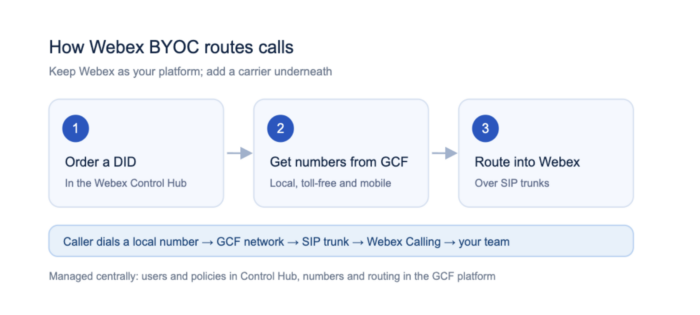
Here’s what a Webex setup looks like when you add Global Call Forwarding for international numbers. Webex stays the platform your teams use every day, while we handle the numbers and connectivity behind the scenes:
- Webex Calling handles users and collaboration – Teams keep the softphones, devices, meetings, and messaging they already use, with no change to the day-to-day experience.
- The carrier provides the numbers – Global Call Forwarding supplies local, mobile, and toll-free numbers in each target market and activates them once the required documentation is in place.
- Calls route into Webex – You order a DID number in the Webex Control Hub, then set your Global Call Forwarding number to forward calls to it. Calls to your local or toll-free number ring straight through to Webex Calling.
- Everything is managed centrally – Users and calling policies stay in the Webex Control Hub, while numbers, routing, and reporting live in the carrier platform, giving IT one clear place for each layer.
Regions Commonly Supported via BYOC
BYOC is most valuable in the regions bundled plans reach last. A specialized carrier can extend global Webex calling into markets across:
- Latin America — including Brazil, Mexico, and Colombia, where local presence drives trust.
- Middle East — where documentation and in-country rules make bundled provisioning slow.
- Africa — where toll-free and local coverage is often thin under native plans.
- Asia-Pacific — where a mix of local, national, and toll-free numbers is needed across many markets.
Use Cases
Webex BYOC earns its place in specific situations rather than every deployment. The 4 scenarios below show where enterprise teams put it to work most often.
A) Global customer support rollouts. A company building out support in new regions can buy local and toll-free numbers in each country and forward them into its central Webex teams. Customers dial a familiar local phone number, and the call rings through to the right agents in Webex.
B) Regional sales presence. In-country numbers give sales teams a local presence that improves trust and pickup rates in each market. With BYOC, an enterprise can present a local number in every region while its reps continue working inside Webex.
C) M&A telecom consolidation. Acquisitions often leave a business with a patchwork of carrier contracts across countries. BYOC lets the combined organization keep Webex as the standard platform while consolidating fragmented carriers under one partner, simplifying billing and management.
D) Global business continuity. Because your numbers and carrier sit outside Webex, you can build in backup routes across regions. If a route or region has trouble, calls reroute through the carrier’s global network, keeping your international lines available.
How Global Call Forwarding Supports Enterprise Webex BYOC Strategies
Webex gives enterprises a strong collaboration foundation, and a specialized carrier is what turns it into dependable global voice. When evaluating a carrier partner for a Webex BYOC deployment, enterprise teams should look for a few essentials: coverage across multiple countries including hard-to-reach markets, compliance and documentation expertise, faster provisioning, flexible routing, and responsive 24/7 support.
It helps to do a little homework here: do comparative research, read customer reviews and testimonials and ask the provider’s sales team direct questions about coverage, provisioning timelines, and how they handle outages.
Global Call Forwarding was built for exactly this role. We provide access to 18,000+ local, mobile, and international toll-free numbers across 160+ countries — including the underserved regions across Africa, the Middle East, Southeast Asia, and Latin America that bundled plans reach last. Our team provisions and activates those numbers with the local documentation handled for you, backed by a highly redundant network with Tier-1 voice routes and global Points of Presence.
Adding us to your Webex setup is simple and doesn’t disrupt anything. You buy the international numbers you need from Global Call Forwarding and forward them into your Webex Calling environment, so your teams keep the interface they already know while you extend reach market by market.
And because we handle local telecom compliance, you don’t have to navigate country-by-country rules on your own.
Advanced features come along with our virtual phone numbers, too! Included Custom Reports for call analytics, plus Call Recording, IVR, and intelligent call routing. For deeper insight, AI Call Insights is available as a premium add-on.
And 24/7 US-based support means help is a real person, not a ticket queue. Learn how to add our cloud phone services and forward calls to Webex.
Need International Phone Numbers for Your Webex Deployment?
Our telecom specialists can help you identify the right local, toll-free, or mobile numbers, configure routing to your Webex DID, and build a scalable global voice strategy.
Our telecom experts at Global Call Forwarding can help you map the right numbers, routing, and coverage for your global deployment.
Call us at +1 (561) 908-6171 or chat with us online.
