
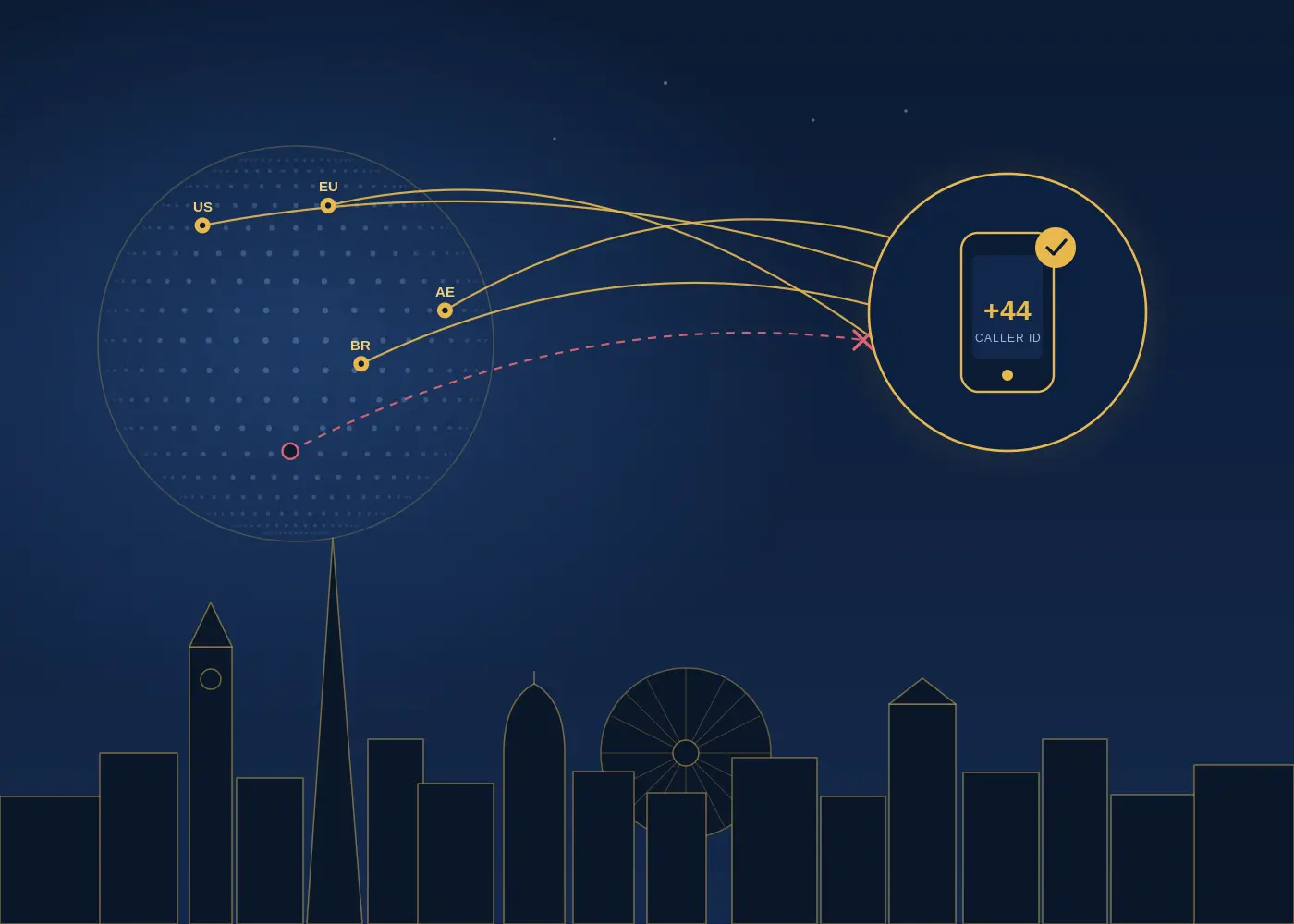
Phone scams have made United Kingdom (UK) consumers cautious about answering unknown numbers. An Office of Communications (Ofcom) research found that 48% of UK landline users received a suspicious call over a recent 3-month period, and UK Finance data attributes around 28% of authorised push payment (APP) fraud losses to telephone-based scams, which tend to be higher value. In response, UK regulators and carriers have tightened the rules on how calls terminate on the UK network, especially calls that arrive from abroad while displaying a UK caller ID.
For international businesses, this shift has real consequences. Calls to UK customers can now be blocked, degraded, or hit with per-minute surcharges depending on how a provider routes them.
In this guide, we’ll cover:
- What is Changing for Calls Terminating in the UK
- How Calls Reach the UK Network
- Why the UK And Europe are Getting Stricter
- Why Surcharges are being Added
- What these Changes Mean for your Business
- How to Stay Compliant
- How Global Call Forwarding Helps
Key Takeaways
- Ofcom now requires UK providers to block many international calls that display a UK phone number as their Calling Line Identification (CLI)
- Carriers can also add origin-based surcharges to calls that terminate in the UK from certain countries
- The common thread is a move away from sending UK-bound calls in over international routes while presenting a UK caller ID — a practice carriers increasingly block or hit with steep surcharges
- In-country origination, such as Local 2-Way Voice, is becoming the reliable, compliant way to reach UK customers
What is Changing for Calls Terminating in the UK
Two regulatory shifts are now reshaping how calls are allowed to enter the UK network. One targets the caller ID a call displays, and the other targets what it costs to connect a call from abroad.
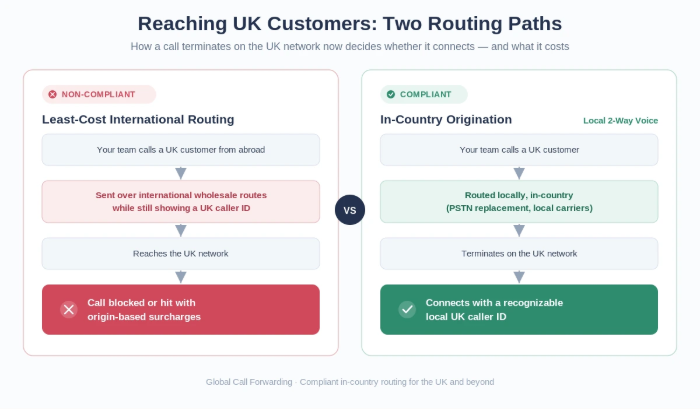
What “Call Termination” Means: Call termination is the final leg of a call, where it connects to and completes on the recipient’s network. There is an important distinction in how a UK-bound call gets there. With local termination, the call is delivered directly on a UK network. With UK-to-UK call termination via international routes, a call that presents a UK number is carried through international wholesale carriers before it reaches the UK. It is the second that regulators and carriers are now discouraging, either by blocking it or by adding steep surcharges.
1. Ofcom Now Blocks International Calls Displaying a UK Number
The first shift is stricter Calling Line Identification (CLI) rules from Ofcom, the UK’s communications regulator. Under updated CLI guidance in force since 29 January 2025, UK providers are required to identify and block calls that arrive from abroad while displaying a UK number as their caller ID, unless the call meets a recognized, legitimate exception. This does not stop ordinary international calls to the UK; for example, a business calling a UK customer from its own (non-UK) number is unaffected. What it targets is calls from outside the UK that present a UK number they are not entitled to use, a common tactic behind caller ID spoofing and fraud.
2. Carriers Are Adding Origin-Based Surcharges
The second shift is commercial. UK carriers are allowed to add origin-based surcharges to calls that terminate in the UK, charging more depending on where the call originates. Together, these changes mean the old approach of pushing UK-bound traffic through the cheapest international route while showing a UK number is being either blocked outright or made deliberately expensive.
How Calls Reach the UK Network
Using international routes for UK calls used to be a way to save money, but it made those calls less trustworthy. A call handed between wholesale carriers on its way to the UK is hard to authenticate, and it can arrive showing a UK caller ID even though it never originated on a UK network. That is the gap fraudsters have exploited, and it is what the new rules are built to close.
Ofcom’s Role in Caller ID Accuracy
Ofcom’s role is to protect UK consumers and keep the telecoms market working fairly, and CLI accuracy sits at the center of that job. Its CLI guidance sets out how local caller ID data should be carried across networks and which party is responsible at each step.
For calls arriving from abroad, the responsibility falls on the provider at the first point of entry into the UK; the international gateway. That provider is expected to satisfy itself, usually by contract, that the necessary checks have been carried out before the call is accepted.
The Industry is Tightening Routing Standards
The industry as a whole is moving in the same direction. Carriers are applying more scrutiny to internationally originated traffic, adopting caller ID authentication approaches, and either refusing or surcharging calls that don’t meet the standard. For businesses, the practical result is that how a call is routed now matters as much as the number displayed on it.
Why the UK and Europe Are Getting Stricter
A) Cracking Down on Fraud and Spoofing
The driving reason is fraud. Scam callers spoof trusted UK numbers to trick people into handing over money or personal details, and the phone remains one of the most damaging channels for this kind of crime. By requiring providers to block international calls that falsely present UK numbers, Ofcom is closing a loophole that fraudsters have relied on for years.
B) Rebuilding Trust in the Phone
When consumers can’t tell a legitimate business call from a scam, they stop answering unknown numbers altogether, which hurts every company that needs to reach customers by phone. Cleaning up caller ID is meant to restore confidence that a call showing a UK number genuinely comes from a legitimate UK source.
C) Safeguarding Across the Region
The UK is not acting alone. Regulators across Europe — including Belgium, the Czech Republic, Germany, Ireland, Italy, Malta, Poland, and Sweden, among numerous other countries— have introduced rules requiring carriers to block international calls that present local caller IDs unless they can be verified. Europe is steadily moving toward a standard where local termination via international routes is either blocked or actively discouraged, so compliant in-country routing has become a Europe-wide concern rather than a UK-only one.
Why Surcharges Are Being Added
Alongside the blocking rules, cost is being used as a lever. Ofcom’s Wholesale Voice Markets Review, which set the framework for this period, allows UK carriers to charge more to terminate an incoming international call than they can for a domestic one — but only where the UK provider itself faces a high termination charge from its international counterpart and only up to that reciprocal rate. The extra fee is applied per minute, on top of the standard termination rate, and it varies by the call’s country of origin and the type of number being called.
Where the Charges Show Up
These origin-based surcharges are already in force, and they are visible in the sign-up flow for many global telephony providers. Calls terminating to UK numbers from certain origin countries carry a clearly listed per-minute surcharge, so the cost of reaching a UK customer can depend on where your traffic originates rather than only on where it lands. The purpose is to reflect the genuinely higher cost of certain international routes and to discourage the least-cost routing patterns that regulators associate with spoofing and fraud.
How Providers Are Responding
Some UK providers have gone a step further and taken a protective stance, refusing to let customers present non-UK caller IDs on outbound calls and blocking calls that would fall under origin-based charging, all to shield their customers from unexpected bills. The direction of travel is consistent: routing a call into the UK cleanly and locally is becoming the predictable option, while relying on international workarounds is becoming both riskier and more costly.
What These Changes Mean for Your Business
If your teams call UK customers from abroad or through a cloud platform hosted outside the UK, these changes can affect your operations in several ways. The impact tends to show up first for international sales, support, and collections teams that depend on connecting with UK contacts reliably.
- Higher costs on some outbound calls: Calls that terminate in the UK from certain origin countries can carry per-minute surcharges, raising the cost of routes you may have chosen for price.
- Costs that depend on where traffic originates: With origin-based pricing, the same UK destination can cost different amounts depending on the country your call originates from, which complicates budgeting across a distributed team.
- A real risk of blocked or degraded calls: If a call presents a UK number but arrives over a non-compliant international route, a UK provider may block it. Blocked and degraded calls mean missed conversations and lost revenue, on top of higher bills.
- A knock-on effect on customer experience: Calls that don’t connect, or that show an unfamiliar or withheld caller ID, lower answer and callback rates can weaken trust with the customers you’re trying to reach.
- Compliance responsibility that stays with you: Even when calls are made by an offshore team, an outsourced call center, or a cloud service, the business on whose behalf the calls are made remains ultimately responsible for meeting UK rules. That makes your choice of provider and routing a compliance matter as much as a budgeting one.
How to Stay Compliant and Keep Calls Connecting
Staying on the right side of these rules comes down to how your outbound calls to the UK are routed and which provider carries them. The steps below give teams a practical way to reduce both the compliance risk and the surcharge exposure. Note: Confirm the specifics of your own setup with a qualified provider, since requirements differ by country and change over time.
1. Review how your outbound UK calls are routed today.
Ask your current provider whether calls to UK numbers are delivered over compliant, in-country paths or over international wholesale routes, and whether the UK caller ID you present is valid, dialable, and uniquely tied to you.
2. Choose a provider with compliant in-country routing.
A provider that delivers UK-bound calls on a UK network, rather than through least-cost international hops, keeps your calls inside the rules and out of the surcharge brackets. The provider owns and manages that routing, so this is largely a matter of selecting the right partner.
3. Consider local origination such as Global Call Forwarding’s Local 2-Way Voice.
Making outbound calls from a genuine local number, terminated locally, lets you present a recognizable UK caller ID legitimately while avoiding the routing patterns that trigger blocking or surcharges.
4. Work with a provider that tracks regulatory change.
UK and European rules are still evolving, with new Ofcom guidance set to raise CLI accuracy standards further and additional measures targeting scam calls from abroad under way. A provider that monitors carrier requirements and regulatory updates keeps your routing compliant as the rules shift.
How Global Call Forwarding Helps You Reach UK Customers
Getting UK calls to connect reliably now depends on routing them locally and compliantly, and that is exactly what a specialized global telephony provider is built to handle. When you evaluate a partner for UK and European calling, look for genuine in-country routing, transparent origin-based pricing, caller ID that’s valid and verifiable, and a team that keeps up with regulatory change.
To check those claims, read customer reviews and testimonials and ask the provider’s sales team direct questions about how they route UK-bound traffic and how they handle surcharges.
Local 2-Way Voice for Compliant UK Calling
Global Call Forwarding is built to help your business address these challenges. Our Local 2-Way Voice service uses Public Switched Telephone Network (PSTN) replacement and long-term relationships with local carriers to provide true local numbers, so calls to and from those numbers travel over local routes instead of international ones, where call completion may not always be guaranteed and additional surcharges may apply.
For calls terminating in the UK, that means delivery on a UK network and a recognizable local caller ID, which supports higher pickup and callback rates and keeps your calls clear of the routing patterns that get blocked or surcharged. Our team manages the local carrier relationships, and origin-based surcharges are shown transparently during sign-up so there’s no surprise on the bill.
The service fits how your teams already work. Use UK virtual phone numbers and local numbers across the markets you serve, and rely on a redundant global network with Points of Presence worldwide for consistent voice quality. With global voice coverage across 160+ countries, the same approach extends to the other European markets adopting similar rules.
Want To Make Sure Your Calls To UK Customers Keep Connecting?
Our telecom experts at Global Call Forwarding can help you set up compliant in-country routing for the UK and beyond. Call us at +1 (561) 908-6171 or chat with us online.
