
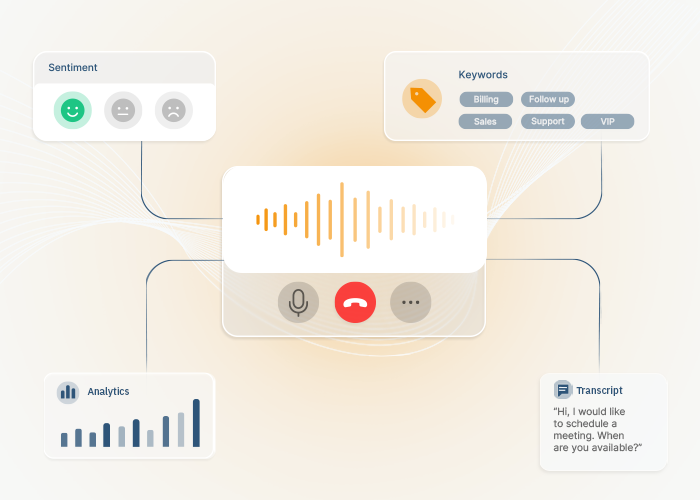
A support lead in Singapore, a sales manager in Frankfurt, and a VP of operations in Chicago are all looking at the same customer base and drawing different conclusions from it. Each has call volumes and durations, but almost nobody has the substance of the conversations. Manual quality reviews realistically cover a small sample of total volume, which leaves most of what customers said unexamined.
Conversational intelligence closes that gap by analyzing the content of calls at scale. The timing matters because voice moved to the cloud first: once calls run over Voice over Internet Protocol (VoIP), the audio and its metadata are already digital and available for analysis. Grand View Research projects the speech analytics market to grow at a compound annual rate above 15%, on its way past $7 billion. 85% of customer service leaders plan to explore or pilot customer-facing conversational generative AI. For a global sales, support, or IT leader, the practical payoff is a single, comparable view of conversations across every region you operate in. In this guide, we’ll cover:
- What is Conversational Intelligence?
- How Conversational Intelligence Software Works
- Key Features and Capabilities
- How to Use for Your Business
- Choosing the Right Conversational Intelligence Solution
Key Takeaways
- Conversational intelligence software applies Automatic Speech Recognition (ASR), Natural Language Processing (NLP), and machine learning (ML) to voice conversations, producing transcripts, summaries, sentiment scores, keyword trends, and topic tags.
- It differs from conversational AI: conversational intelligence analyzes conversations humans have, while conversational AI holds the conversation itself through voice agents and bots.
- The capabilities that matter most for multi-region teams are transcription and summaries, keyword and topic alerts, sentiment detection, quality scoring, multilingual coverage, integrations with your Customer Relationship Management (CRM) system, and cross-region dashboards.
- With Global Call Forwarding, Call Activity, Custom Reports, and Call Detail Records (CDRs) come with our virtual phone number plans, while AI Call Insights and Call Recording are add-ons you can try for free.
- Choosing a platform for international teams comes down to language and accent coverage, fit with your cloud Private Branch Exchange (PBX) or VoIP setup, reporting flexibility, and provider support in the regions you sell and serve in.
Conversational Intelligence: Definition and Evolution
Conversational intelligence is the practice of using AI to analyze the content of business conversations and turn them into data teams can act on. Traditional telephony reporting told you the who, when, and how long of a call. Conversational intelligence tells you the what and the why.
The technology grew out of speech analytics, which searched call audio for specific words and phrases. As speech recognition accuracy improved and large language models (LLMs) arrived, the scope widened from keyword matching to understanding meaning, intent, and tone. AI now handles the listening and the first pass of interpretation, so managers spend their time on decisions rather than on playback.
The data a conversation intelligence platform can analyze goes well beyond the audio. Most platforms combine the voice stream or call recording, the transcript generated from it, call metadata such as origin country, destination, duration, and routing path, call detail records (CDRs), and business context pulled from a CRM or help desk. Some also take in chat transcripts and video meeting audio.
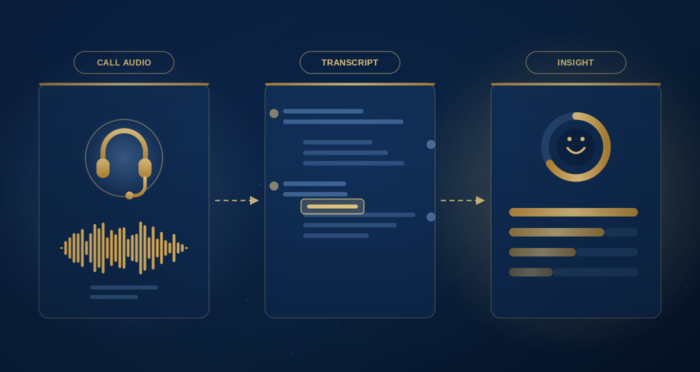
A call transcript on its own is raw text. Conversational intelligence adds a layer of interpretation on top of it: sentiment scoring, topic grouping, alerts when a competitor or a cancellation phrase comes up, and a 20-minute call condensed into 5 lines. Those outputs then roll up across your call volume, so you can compare one region’s support themes against another’s, for example.
Conversational Intelligence vs Conversational AI
These terms get used interchangeably, and they describe different jobs. Conversational intelligence analyzes conversations that already happened between people, while conversational AI participates in the conversation, answering customers through voice agents, chatbots, or interactive voice response (IVR) flows. Many businesses run both, using AI agents to handle routine contacts and conversational intelligence to measure how every contact went.
Speech analytics, call tracking, and quality assurance (QA) sit close by as well. Each answers a narrower question than conversational intelligence does, and the table below separates them so you can tell which tool solves which problem.
| Approach | What It Does | Primary Output |
| Conversational intelligence | Analyzes the content of human conversations at scale | Transcripts, summaries, sentiment, topic trends, coaching insight |
| Conversational AI | Holds the conversation with the customer | Automated answers, self-service resolution, call deflection |
| Speech analytics | Searches call audio and transcripts for words and phrases | Keyword hits, phrase frequency, script adherence |
| Call tracking | Attributes inbound calls to marketing sources | Source, campaign, and channel attribution per call |
| Traditional QA | Human reviewers score a sample of calls against a rubric | Scorecards for a small percentage of total calls |
The distinction that matters operationally is coverage. Human QA reviews a sample, and conversational intelligence reviews everything, which is why the two are usually paired rather than swapped.
How Conversational Intelligence Software Works
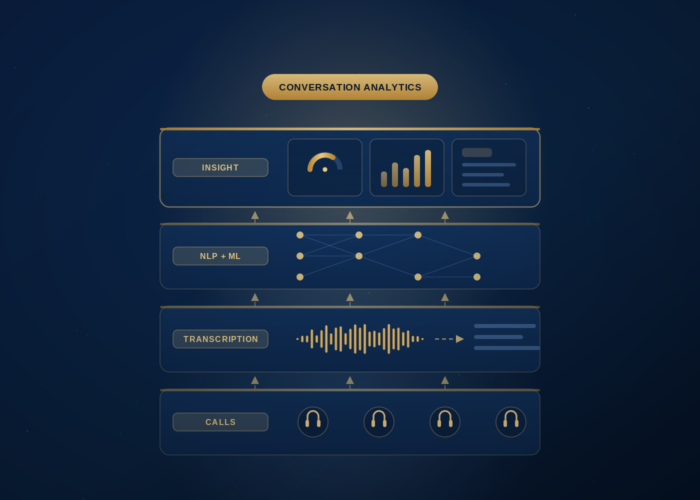
The pipeline is consistent across platforms, even when the underlying models differ. It starts with capture and ends with insight delivered somewhere a team already works.
1. Data capture: The platform ingests voice streams or completed call recordings, along with Session Initiation Protocol (SIP) metadata and CDRs that describe how the call was routed, from where, and for how long.
2. Call transcription: ASR converts the audio into text. IBM describes speech recognition as the capability that processes human speech into a written format using AI and machine learning, and modern engines handle speaker separation so each side of the conversation is labeled.
3. Language analysis: NLP and ML models read the transcript to identify intent, entities, topics, and questions. Large language models handle the call summaries and the more open-ended interpretation.
4. Sentiment and tone scoring: Models assess whether a conversation trended positive, neutral, or negative, and some evaluate pace, interruptions, and talk-to-listen ratio.
5. Keyword spotting, alerts, and call tagging: Rules and models flag defined terms such as a competitor name, a refund request, a compliance phrase; then auto-tag the call and notify the right person.
Processing happens either during the call or after it. In-call processing powers live agent prompts and supervisor alerts, while post-call processing handles transcripts, summaries, and sentiment trends once the conversation ends. Multilingual coverage is the variable that trips up global teams most often: accuracy varies by language, accent, and dialect, and a platform strong in North American English can struggle with Singaporean English or Brazilian Portuguese. Ask for accuracy detail on the specific markets you operate in.
What Are Key Features and Capabilities for Global Teams?
Feature lists across vendors look similar until you apply them to a business that runs in 6 time zones. The capabilities below are action items that change how a distributed team works, and several are available through Global Call Forwarding’s AI Call Insights add-on.
Turn Every Call Into a Readable Record
Automatic Call Transcription converts inbound and outbound conversations into searchable text, and automated Call Summary output condenses each one into the key topics discussed. A manager reviewing 40 calls from an overnight shift can scan summaries in a few minutes rather than replaying audio, and a colleague picking up a handover has the context in writing.
Catch Emerging Issues Before They Become Trends
Keyword and topic detection flags defined terms across your call volume and alerts the right team when frequency spikes. A sudden rise in a shipping-delay phrase across Europe, the Middle East, and Africa (EMEA), or a competitor’s name appearing more often in sales conversations, becomes visible within days instead of surfacing in a quarterly review. Keyword search across transcripts also lets you check a hunch on demand.
Measure How Customers Feel
Sentiment Analysis scores the emotional tone of a transcribed call and identifies patterns across many calls. Used well, it works as an early-warning signal: a dip in sentiment on one product line or in one market gives you something to investigate before churn shows up in the numbers. Treat scores as directional rather than absolute, and read them alongside outcomes.
Ask How a Platform Scores Quality at Scale
Some platforms offer automated call scoring and auto quality management, applying a consistent rubric to your full call volume. Teams use these tools to check whether required disclosures were read, whether agents followed the discovery framework, and where coaching would have the biggest effect. If this matters to you, ask vendors whether scoring rubrics can be customized per region, since expectations and regulations differ by market.
Decide Whether You Need Live Agent Guidance
On some platforms, in-call intelligence surfaces prompts, objection-handling suggestions, and knowledge-base answers to the agent mid-conversation, and alerts a supervisor when a call goes sideways. This is the most demanding capability in the category to deliver well, and it depends heavily on low-latency transcription in the agent’s language. Teams supporting newer agents or complex products should evaluate it closely, while others get more value from stronger post-call analysis.
Analyze Conversations in the Languages You Sell In
Multilingual coverage decides whether your analytics are complete or only cover headquarters. Look for transcription across your active markets, plus translation so a manager in one region can read a conversation held in another. Our Call Translation feature translates call transcripts across 50+ languages so leaders reviewing global performance are reading the same material.
Connect Insight to the Tools Your Teams Already Use
Conversational intelligence earns its keep when the output lands where work happens. Voice integrations push sentiment, summaries, and transcripts into a CRM or help desk, so account owners see conversation history against the record. Check that a platform connects to your CRM, help desk, cloud PBX, and business intelligence stack, and that an application programming interface (API) is available for anything custom.
Compare Performance Across Regions on One Screen
Dashboards, alerts, and benchmarking turn individual call insight into management information. The useful version lets you filter by number, country, team, and time period, then compare regions against each other and against your own baseline. Custom Reports and Call Activity come with our virtual phone number plans, cover caller details, duration, forwarding destination, and outcomes, and can be scheduled to arrive in your inbox on a set cadence.
How to Implement Conversation Intelligence Across My Business?
The value of conversation analytics depends on which team is asking the question. Below are 5 patterns we see most often, along with the combinations of international virtual numbers, routing, and analytics that make each one work.
1. Give Sales Teams Evidence Instead of Anecdotes
Revenue teams use transcripts and sentiment to find out which pitches, objections, and competitor mentions correlate with closed deals. A practical setup for global sales teams selling into several countries pairs local phone numbers in each target market with our Outbound Calling service and Local Caller ID, then layers AI Call Insights on top. You get transcripts and sentiment per market, and Custom Reports segmented by line show which markets and which reps are converting.
2. Find the Repeat Issues Driving Your Ticket Volume
Support and contact center leaders use topic clustering and summaries to identify what customers keep calling about. For distributed support teams, our Advanced IVR and Time-of-Day Routing send each call to the right regional queue, and Call Activity reports reveal peak times and missed call patterns. Add AI Call Insights, and Call Summary and Sentiment Analysis show how those conversations went, so recurring themes can feed your knowledge base and agent training.
3. Feed Real Customer Language Back Into Marketing and Product
Marketing and product teams get unfiltered customer vocabulary from call transcripts: the words people use to describe a problem, the features they ask for, and the objections that repeat. Separate virtual numbers for each campaign or region keep attribution clean, and keyword search across transcripts shows which campaigns generate the questions worth answering on your website.
4. Compare Regional Performance on Common Ground
Operations and leadership need comparability more than depth. Local numbers in each market give you clean per-country volume, and geographic and time-based routing controls where those calls land. Our scheduled Custom Reports then deliver the same metrics for every region on the same cadence, and Call Translation, available within the AI Call Insights add-on, renders conversations in a language your reviewers can read. Parent and child account structures let regional managers see their own data while headquarters keeps the consolidated view.
5. Build a Searchable Audit Trail
Risk and compliance teams use conversational intelligence to verify that required disclosures were delivered and to retrieve evidence when a dispute arises. Our Call Recording add-on captures the audio, and Call Transcription and keyword search within AI Call Insights locate a specific phrase across thousands of calls rather than a folder of recordings. Your team configures consent notifications, retention windows, and access permissions to match the rules in each market you operate in.
See what your calls are telling you. AI Call Insights brings transcription, summaries, sentiment analysis, keyword search, and translation to your Global Call Forwarding numbers, and you can try it for free. Explore AI Call Insights.
How to Evaluate and Choose the Right Conversational Intelligence Solution
Most platforms demo well. The differences show up once you map them against a multi-country phone estate, so work through the following 7 checks before you commit.
1. Match the Feature List to How You Operate
Start with the questions you want answered, then work backward to features. A team that needs to understand support themes has different requirements than one coaching outbound reps. Separate what you need at launch from what you might want later, and confirm that the shortlist covers both inbound and outbound conversations.
2. Confirm It Fits Your Existing Voice Setup
Ask specifically how the platform connects to your current cloud PBX, VoIP provider, or contact center, and where in the call path the audio gets captured. A conversational intelligence layer that sits alongside your existing numbers and routing is far less disruptive than one that requires you to move your phone system. Analytics that come with your voice service remove the integration question entirely.
3. Verify Language and Accent Coverage in Your Markets
Request accuracy detail for the exact languages, accents, and dialects your customers use, not a headline count of supported languages. Ask for a sample transcript from a real call in your hardest market, and check whether translation is included or priced separately. This is where global deployments most often disappoint.
4. Pressure-Test How It Scales
Growth in this context means more countries, more numbers, more users, and more stored conversations. Ask what happens to processing time and cost as volume rises, whether new markets can be added without a new contract, and how storage and retention scale. Confirm that adding a country is a configuration change rather than a huge project.
5. Check Whether the Data Can Leave the Dashboard
Reporting flexibility determines whether insight reaches decision-makers. Look for custom report builders, scheduled reports, exports, and an API for pushing conversation data into your own warehouse or business intelligence tool. Dashboards that only work inside the vendor’s interface tend to go unused after the first month.
6. Understand What You Are Paying For
Pricing models vary per seat, per minute, per call, per number, or per region; and each favors a different usage pattern. Model your real volume against each structure, and ask which capabilities are included versus priced as add-ons.
7. Judge the Provider Alongside the Product
Global coverage means the provider can support you where you operate. Read customer reviews and case studies, then put direct questions to the sales team:
- Which countries can you provision numbers in?
- How long does number activation take?
- Who handles the regulatory documentation?
- Is support staffed 24/7, and where is the team based?
- Will we have a named account manager?
For reference, our team activates numbers in 160+ countries, typically within 2–3 business days once documentation is in order. Our US-based support team is available around the clock, and every account gets a dedicated account manager.
Factor in Where Conversational Intelligence is Heading
The category is moving quickly, so a platform decision made now should account for what arrives next. There are 4 directions worth weighing as you plan.
A) Autonomous voice agents with clean handoff: AI voice agents are taking on routine contacts, and the question is how gracefully they hand a conversation to a human with full context attached. Expect handoff quality to become a primary evaluation criterion.
B) Predictive analytics: Platforms are moving from reporting on what happened toward anticipating it, flagging likely objections and at-risk accounts and suggesting the next action while there is still time to influence the outcome.
C) Prompt-driven analysis: Instead of building a report, managers can ask a question in plain language and get an answer drawn from their own conversation data. This is on our roadmap as Prompt-driven Analysis, listed as coming soon on our AI Call Insights feature.
D) Cross-modal and orchestrated intelligence: Voice, chat, and video analysis are converging into one view of the customer relationship, with conversation orchestration coordinating handoffs between phone, chat, and voice agents so context travels with the customer rather than resetting at each channel.
Getting Advanced Conversational Analytics with Global Call Forwarding
Conversational intelligence has become the practical way for global teams to understand what happens on their calls, because sampling a handful of conversations across several regions no longer produces a usable picture.
The teams getting the most from it treat conversation data the way they treat web analytics: measured continuously, compared across markets, and reviewed on a schedule.
What makes this work at an international scale is the layer underneath the analytics. Global Call Forwarding provides virtual phone numbers in 160+ countries, with the routing, IVR, and reporting to run them as one system.
That means the conversations you want to analyze are already flowing through a single platform. Call Activity, Custom Reports, and Call Detail Records come with our virtual phone number plans. AI Call Insights is an add-on that layers on Call Transcription, Call Summary, call analytics built on Sentiment Analysis and keyword search, and translation across 50+ languages. Our team handles number provisioning, and our network runs on geo-redundant points of presence with Tier-1 carriers.
Want To See What Your Global Call Traffic Can Tell You?
Our telecom experts at Global Call Forwarding can help you set up the numbers, routing, and analytics to find out. Call us at +1 (561) 908-6171 or chat with us online!
