

Unwanted marketing calls became one of the most common consumer complaints in the United Arab Emirates (UAE), and the government responded with a framework that puts real cost behind the rules. Cabinet Resolutions 56 and 57 of 2024 took effect on 27 August 2024, and enforcement followed quickly: the Telecommunications and Digital Government Regulatory Authority (TDRA) identified more than 2,000 individuals and businesses in violation within the first weeks, and Dubai’s economic authority fined 159 companies AED 50,000 each after an initial round of warnings.
For companies headquartered outside the UAE, the practical effect is bigger than a compliance checklist. The rules tie legitimate telemarketing to a UAE commercial license and to local phone numbers registered under that license, which changes how a global sales or outreach team can operate in the market at all.
Key Takeaways
- Cabinet Resolution No. 56 of 2024 sets the telemarketing rules, and Cabinet Resolution No. 57 of 2024 sets the fines. Both took effect on 27 August 2024
- Telemarketing requires prior approval from the authority that licenses your economic activity, plus local phone numbers registered under your commercial license
- Companies must check the Do Not Call Register (DNCR) before dialing, keep call records, record calls with notice, and call only between 9:00 am and 6:00 pm
- Fines for companies run from AED 10,000 to AED 150,000 per violation type, with escalation for repeat offenses, activity suspension of 7 to 90 days, and license cancellation in serious cases
- The rules apply to companies licensed in the UAE, including free zones, so an unlicensed foreign business has no compliant route to run a UAE telemarketing campaign
- Neighboring GCC markets have lighter telemarketing rules, which makes regional numbers a practical alternative for outreach and a way to keep inbound support coverage intact
Why the UAE Tightened Its Telemarketing Rules
The pressure came from consumers. Residents in the UAE were fielding repeated marketing calls about property, insurance, credit cards, and loans, often from numbers with no traceable business behind them, and the volume turned into a sustained stream of complaints to regulators. TDRA had already launched a national Do Not Call Register in 2022, but a register alone doesn’t stop a caller who faces no consequence for ignoring it.
Two gaps kept the problem alive.
- Individuals could dial from personal mobile numbers with nothing tying the call back to a licensed business
- And companies buying consumer lists from third parties had little obligation to explain where the data came from.
The 2024 resolutions close both gaps by attaching telemarketing to a commercial license, to registered numbers, and to a penalty schedule that grows with each repeat.
What the DNCR Is: The Do Not Call Register is a unified national register managed by TDRA. UAE consumers add their number to it through their mobile operator, and once a number is listed, companies may not call it for marketing purposes. Registration lasts until the consumer removes the number or the line is disconnected, so the list has to be checked before every campaign rather than once.
What are the New Telemarketing Rules in the UAE?
The framework sits in two instruments issued together on 10 June 2024, published in Official Gazette No. 778 on 28 June 2024, and in force from 27 August 2024. Cabinet Resolution No. 56 of 2024 sets out what telemarketers must do, and Cabinet Resolution No. 57 of 2024 sets out what happens when they don’t.
Resolution 56 defines a marketing phone call broadly. It covers calls made by a company or a natural person to a consumer to market, advertise, or promote products or services, through a landline or mobile number, and it explicitly extends to marketing text messages and marketing messages sent through social media applications. Scope is equally broad on the business side: the rules apply to all companies licensed in the UAE, including those in free zones. Natural persons are barred outright from making marketing calls using a phone number licensed in their own name.
What Cabinet Resolutions 56 and 57 Ask of Businesses
The obligations split cleanly into 3 layers:
- What a company must have in place before it dials,
- How each call must be conducted
- What it costs to get any of it wrong.
A fourth layer sits underneath all of it, since the consumer data driving the campaign is governed by separate privacy law.
Key Business Obligations Under Cabinet Resolution 56
Article 4 lists the company-level requirements, and Article 5 governs the calls themselves. Taken together, they describe a telemarketing operation that is licensed, documented, and auditable.
- Get prior approval before you dial: A company must obtain approval to conduct telemarketing from the competent authority — the government body that licenses its economic activity. Article 9 divides that responsibility: the Ministry of Economy supervises the framework overall, the Central Bank covers banks, financial institutions, and insurance, the Securities and Commodities Authority covers securities and commodities, and the relevant local authority covers everything else. Approval is tied to the emirate that issued the license, so working across emirates can mean more than one approval.
- Use local phone numbers registered under your commercial license: Marketing calls must be placed from local phone numbers issued by UAE-licensed telecom operators, and those numbers must be registered under the company’s commercial license. Using numbers the company doesn’t own or hasn’t registered is a separate, separately punishable violation.
- Check the DNCR before every campaign: Companies may not place marketing calls to numbers listed on the Do Not Call Register. Operators provide business portals where companies can scrub their lists against the register, and the check is free.
- Train your marketers: Staff who make marketing calls must receive comprehensive training on professional conduct, and in practice that training is expected to cover DNCR procedures, since untrained staff is its own fineable offense.
- Keep records and report: Companies must maintain a record of all marketing calls on a form set by the competent authority, hold those records for the period that authority specifies, and submit periodic reports within 1 month of the due date. They must also sign a code of professional conduct.
- Record calls and say so: Marketing calls must be recorded, and the consumer must be told about the recording at the start of the call.
- Identify yourself and your purpose: The company and the reason for the call must be stated at the beginning, and the caller must ask whether the consumer wants to continue before starting to market anything.
- Be ready to prove where the data came from: If the competent authority asks, a company must disclose the source of the consumer phone numbers and data it is using.
- Call only between 9:00 am and 6:00 pm: Outside that window, no marketing calls.
- Respect a “no” and don’t chase an unanswered line: If a consumer rejects the product or service on the first call, the company may not call back about it. If the consumer doesn’t answer or ends the call, contact is capped at once a day and twice a week.
- Skip the pressure tactics: Unjustified pressure, deception, and misleading claims are all prohibited.
Automated calling systems are permitted, but only within these same rules. The resolution creates no lighter track for automated dialing, so an auto-dialer campaign carries every obligation a manually dialed one does.
A Note on B2B Calling: Resolution 56 defines a “consumer” as a natural person, which on the face of the text places genuine business-to-business calling to a corporate entity outside its scope. Treat that as a narrow reading rather than an exemption. Decision-makers are often reached on personal mobile numbers, the DNCR works at the number level and doesn’t distinguish B2B intent, and the requirements around registered local numbers and licensing still shape what a foreign business can practically do. Confirm your own position with UAE counsel before relying on it.
Penalties for Non-Compliance Under Cabinet Resolution 57
Cabinet Resolution No. 57 of 2024 attaches a specific fine in Dirham (AED), the official money used in the UAE, to each obligation and escalates it across the first, second, and third offense. For companies, the schedule spans 18 violation types and runs from AED 10,000 to AED 150,000.
| Violation | 1st offense | 2nd offense | 3rd offense |
|---|---|---|---|
| Telemarketing without prior approval | AED 75,000 (≈ USD 20,422) | AED 100,000 (≈ USD 27,230) | AED 150,000 (≈ USD 40,844) |
| Calling numbers listed on the DNCR | AED 50,000 (≈ USD 13,615) | AED 75,000 (≈ USD 20,422) | AED 150,000 (≈ USD 40,844) |
| Disclosing or trading consumer data without authorization | AED 50,000 (≈ USD 13,615) | AED 75,000 (≈ USD 20,422) | AED 150,000 (≈ USD 40,844) |
| Marketing through unregistered numbers | AED 25,000 (≈ USD 6,807) | AED 50,000 (≈ USD 13,615) | AED 75,000 (≈ USD 20,422) |
| Failing to disclose the source of consumer data | AED 25,000 (≈ USD 6,807) | AED 50,000 (≈ USD 13,615) | AED 75,000 (≈ USD 20,422) |
| Deception or fraud in marketing | AED 25,000 (≈ USD 6,807) | AED 50,000 (≈ USD 13,615) | AED 75,000 (≈ USD 20,422) |
| Calling outside the 9:00 am to 6:00 pm window | AED 10,000 (≈ USD 2,723) | AED 25,000 (≈ USD 6,807) | AED 50,000 (≈ USD 13,615) |
| Calling back after a consumer declines | AED 10,000 (≈ USD 2,723) | AED 25,000 (≈ USD 6,807) | AED 50,000 (≈ USD 13,615) |
| Failing to record calls or maintain a call register | AED 10,000 (≈ USD 2,723) | AED 25,000 (≈ USD 6,807) | AED 50,000 (≈ USD 13,615) |
| No company or purpose identification at the start | AED 10,000 (≈ USD 2,723) | AED 20,000 (≈ USD 5,446) | AED 30,000 (≈ USD 8,169) |
Note: USD equivalents are approximate and based on USD 1 = AED 3.6725.
Three features of the schedule matter more than the individual amounts. The authority can skip the escalation ladder and apply the most severe penalty straight away if a company repeats the same violation within 6 months of a previous penalty.
Beyond fines, it can suspend telemarketing activity for 7 to 90 days, or cancel the license and disconnect service in serious cases. A company that wants to contest a penalty has 15 days from the notice to file a grievance, and the authority must decide within 30 days.
Individuals face a separate track. A first unauthorized marketing call draws an AED 5,000 fine with the number suspended until it’s paid, a second within 30 days draws AED 20,000 and a 3-month suspension, and a third draws AED 50,000 and a 12-month ban on telecom services.
The Data Protection and Consumer Privacy Layer
Telemarketing compliance in the UAE runs on two tracks, and the second one governs the data behind the campaign. Federal Decree-Law No. 45 of 2021, the Personal Data Protection Law (PDPL), makes consent the default basis for processing personal data and requires that consent be clear, unambiguous, easy to access, and provable by the controller. Article 17 gives individuals an explicit right to object to processing for direct marketing, including profiling connected to it.
The picture is layered rather than uniform. The PDPL’s Executive Regulations have not been published, and the law carries no penalty schedule of its own, so Cabinet Resolutions 56 and 57 currently supply the enforcement teeth for telemarketing specifically. Separate regimes apply inside the financial free zones — the DIFC operates under Data Protection Law No. 5 of 2020 and the ADGM under its own Data Protection Regulations — and both give individuals a direct-marketing objection right. The UAE government’s own data protection overview sets out how these regimes sit alongside one another.
One older provision deserves more attention than it usually gets. The Consumer Protection Law, Federal Law No. 15 of 2020, requires suppliers to protect consumer privacy and data security and not to use that data for promotion and marketing, and its penalties reach into criminal territory. For a business assembling a UAE calling list, that makes the provenance of the data as important as the mechanics of the dialer.
Related: Calling the Middle East (Everything You Need to Know)
What This Means for International Businesses and VoIP Users
If your team sits in London, Singapore, or São Paulo and wants to call UAE prospects, the resolutions reshape the question from “how do we route these calls” to “who is legally allowed to make them.” The answer runs through the UAE license, and that has knock-on effects for the numbers you use and the risk you carry.
Why a Foreign Number Won’t Clear the UAE Rules
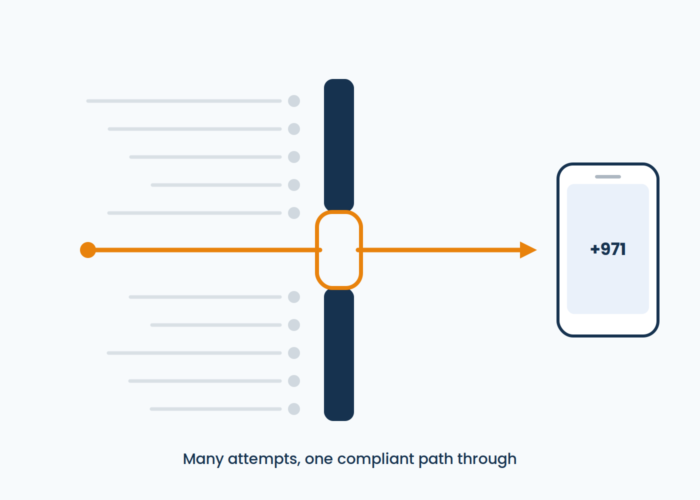
Resolution 56 binds companies licensed in the UAE. It doesn’t create an extraterritorial permission for a foreign entity to opt in, and it doesn’t describe a compliant path for a company dialing from abroad on a foreign number. Instead, the requirements point in one direction: approval comes from the authority that issued your UAE license, and calls must be placed from local numbers registered under your UAE commercial license. A business without that license has no way to satisfy either condition, which is why unlicensed foreign telemarketing into the UAE is a practical dead end rather than a gray area.
The number layer reinforces it. UAE operators and TDRA work at the number level, so marketing traffic arriving on unregistered numbers is exactly the pattern the framework was built to catch. Non-compliance shows up as blocked or suspended numbers and regulatory exposure well before it shows up as a fine.
Related: Navigating International Calling Challenges in the UAE
What it Takes to Get a UAE Local Number
While UAE telecom regulations require a document verification step rather than immediate activation, setup can be straightforward. To get your local business number, you will need*:
- A valid UAE trade license for the entity that will hold the number, issued by a mainland or free zone licensing authority
- Proof of a UAE business address matching the licensed entity
- Identification for the authorized signatory or company representative, typically passport and Emirates ID
- A signed service or registration form naming the entity that will use the number
- Prior telemarketing approval from your competent authority if the number will be used for outbound marketing
*Note: Requirements may change over time.
Because of that paperwork, UAE numbers may take longer to activate than numbers in lighter-touch markets. Plan on a documentation review cycle rather than same-week turnaround, and expect your provider to come back with follow-up requests.
Global Call Forwarding provides UAE virtual phone numbers — including local numbers for Dubai and Abu Dhabi, national (600) numbers, and UAE toll free numbers — and UAE Local 2-Way Voice numbers are available to entities registered in the UAE, as TDRA requires.
How to Ensure Compliance Within the UAE
If your business does hold a UAE license and wants to run outbound campaigns properly, the path is well defined. Work through these 5 steps before the first call goes out, and keep them under periodic review as the framework matures. (Confirm the specifics with UAE counsel and your licensing authority, since requirements differ by emirate and by sector.)
- Apply for telemarketing approval through your licensing authority: Identify which body regulates your activity—the Ministry of Economy, the Central Bank, the Securities and Commodities Authority, or your emirate’s economic department—and secure written approval before any campaign starts. If you operate across emirates, check whether each one requires its own clearance.
- Train your telemarketing staff on the DNCR and call ethics: Build training that covers how to scrub against the register, how to open a call with the company name and purpose, when to stop contacting someone, and what counts as pressure or deception. Document who was trained and when, because the training obligation is enforceable on its own.
- Use only local numbers registered under your commercial license: Register every outbound number to the licensed entity, retire any personal or unregistered lines from campaign use, and keep the registration current when the license is renewed or the entity changes. Presenting a recognizable local caller ID from a properly registered number also does more for answer rates than an unfamiliar international number ever will.
- Maintain call records and file your reports on time: Log every marketing call on the form your authority specifies, retain the records for the period it sets, and submit periodic reports within the 1-month window. A provider-side Call Recording add-on with configurable storage makes the recording obligation manageable, though the retention policy and the consumer notice at the start of each call remain yours to configure and enforce.
- Monitor data privacy and opt-out lists continuously: Track consent and objections against the PDPL, honor direct-marketing opt-outs when they arrive, re-scrub against the DNCR before each campaign rather than once a quarter, and be able to show where every phone number on your list came from.
Alternatives for Regional Outreach Across the GCC
When a UAE license isn’t on the table, or the approval process is still in motion, the wider Gulf gives you room to keep building pipeline. The regulatory picture across the Gulf Cooperation Council (GCC) is uneven, and that unevenness is useful when you’re planning where to put your outbound effort.
Where Neighboring Markets Offer More Room
The UAE currently has the most prescriptive telemarketing regime in the Gulf, and its neighbors sit at various points behind it. Saudi Arabia regulates spam calls and messages through the Communications, Space and Technology Commission’s anti-spam regulations, approved in 2022. Qatar takes a strict line on consent under its data protection law, which prohibits unsolicited direct marketing and carries Qatari Riyal fines up to QAR 5 million. Bahrain relies on notice-and-objection rights under its personal data protection law rather than a dedicated telemarketing regime. Oman has consulted on rules to curb spam and fraudulent messages without adopting a framework, and Kuwait has no specific electronic-marketing provisions.
None of that is an invitation to dial freely. Each market still has consent expectations, carrier rules, and consumer protection law, and several are actively drafting. The practical takeaway is that a Gulf outreach program has more than one viable entry point, and Middle East virtual phone numbers across Saudi Arabia, Qatar, Bahrain, Oman, Kuwait, and Jordan let you build presence in the region while your UAE licensing question resolves.
Keep Your UAE Support Coverage Without Crossing the Line
The restrictions in Resolution 56 apply to marketing calls, which leaves inbound customer service on different footing. A UAE number used to receive calls from your existing customers serves a different purpose than an outbound campaign, so many businesses keep a UAE presence for support while running acquisition outreach from elsewhere in the region.
That split works because routing is handled at the provider level. Your Dubai virtual phone numbers and other UAE lines can forward to a team anywhere in the world, so customers in Dubai or Abu Dhabi dial a local number while the call lands with whichever team is on shift. Pair that with numbers in neighboring markets and you get one coherent Gulf footprint: inbound coverage where your customers already are, and outbound activity where the rules permit it.
How the UAE Compares to Other Privacy-First Markets
Read alongside the world’s other major consent regimes, the UAE framework looks less like an outlier and more like an arrival. The mechanisms differ, but the direction is shared.
| Market | Framework | Core requirement | Maximum exposure |
|---|---|---|---|
| UAE | Cabinet Resolutions & 57 of 2024 | Prior approval, registered local numbers, DNCR scrubbing, 9:00 am–6:00 pm window | AED 150,000 per violation, activity suspension, license cancellation |
| EU | GDPR + ePrivacy Directive | Prior consent for automated calls, fax, and email marketing; live calls are opt-in or opt-out by member state | €20 million or 4% of global annual turnover, whichever is higher |
| US | TCPA + FTC Telemarketing Sales Rule | Consent for automated and prerecorded calls; mandatory scrubbing against the National Do Not Call Registry | $500 per violation in private actions, trebled to $1,500 for willful violations, plus FTC civil penalties |
| Singapore | PDPA, Part 9 (Do Not Call) | Check the national DNC Registry before sending specified marketing messages | S$1 million for organizations, S$200,000 for individuals |
The UAE’s distinguishing feature is how much of the burden sits at the number and licensing layer rather than the consent layer alone. Europe and Singapore ask whether you had permission to contact someone. The UAE asks that too, and then asks whether you were approved to run the activity and whether the line you dialed from is registered to your business. That makes telephony architecture part of compliance in a way it isn’t everywhere else.
The broader GCC is moving the same way. Saudi Arabia, Qatar, and Bahrain have each built consent or anti-spam requirements into their frameworks over the past several years, and regional alignment around privacy-first marketing is the clear trend. A business designing its Gulf calling strategy around the UAE’s requirements today is unlikely to be caught out by what its neighbors adopt next.
How Global Call Forwarding Supports Compliant Calling in the Gulf
Regulations like these change what a phone number has to do. It has to be genuinely local, correctly registered, and backed by a provider who understands what the market’s regulator expects. And that’s the work a specialized international carrier is built for.
When you evaluate a partner for UAE and GCC calling, ask how they handle in-country registration requirements, what documentation they’ll need from you, how quickly they move once it’s submitted, and how they keep up as rules change. Reading customer reviews and putting those questions directly to a sales team tells you more than a feature list will.
UAE Local 2-Way Voice for Registered Entities
Global Call Forwarding has been provisioning international numbers since 1996, which means nearly 30 years of working through exactly this kind of in-country requirement. Our Local 2-Way Voice service supports inbound and outbound calling on a genuine local number, so your team can receive calls and place them with a recognizable UAE caller ID rather than an international one. For the UAE specifically, we provide Local 2-Way Voice numbers to entities registered in the country, in line with what TDRA requires. Our team handles the carrier relationships and the registration process, and we’ll tell you upfront what documentation your license needs.
Pair it with an Outbound Calling plan to dial from your business number, and use Call Recording to satisfy the recording obligation with storage you control. Our support team is US-based and available 24/7, and dedicated account managers work through the documentation stage with you rather than handing you a form.
Regional Coverage When UAE Telemarketing Is Restricted
Choose a partner that can grow with your client base. Our telecom experts can help you map your markets to the destinations that make sense for cost, quality, and compliance. Call us at +1 (561) 908-6171 or chat with us online!
