


Home » Archive by category 'Industry Voice'

How Global Enterprises Can Use Webex BYOC to Scale Global Voice

Illustration of bringing your own carrier with Webex

Webex Calling is one of the most capable unified communications platforms an enterprise can run, and the broader UCaaS market it belongs to is projected to reach $404.25 billion by …Read More »

Customer Support in the GCC: Ensuring Reliable Support with Cloud Telephony

An illustration of global customer support across GCC countries

The Gulf Cooperation Council (GCC) is one of the fastest-digitizing regions in the world. The World Bank reports that GCC economies are accelerating their digital transformation as they diversify beyond …Read More »

Plug-and-Play vs. Backend Voice Integrations: Which is Right for Your Global Voice Strategy?

An illustration comparing plug-and-play vs. backend voice integrations

Modern business communication is no longer just about having a phone system—it’s about integrating voice into the tools your teams already use. Whether that’s your CRM, helpdesk, or contact center …Read More »

Adding International Phone Numbers to Amazon Connect

Adding international phone numbers to Amazon Connect

Amazon Connect has become a popular choice for organizations building modern, cloud-based contact centers. It’s scalable, flexible, and tightly integrated with the AWS ecosystem. But when companies expand beyond a …Read More »

6 Months in Brazil: What We’ve Learned While Building Our São Paulo Hub

Stylized illustration of the São Paulo skyline and Ponte Estaiada bridge for a business growth retrospective in Brazil.

Six months ago, Global Call Forwarding officially opened its Brazil office. At the time, the goal was clear but focused: build a strong foundation for IT and AI-driven development while …Read More »

What is Genesys SIP Integration? A Beginner’s Guide

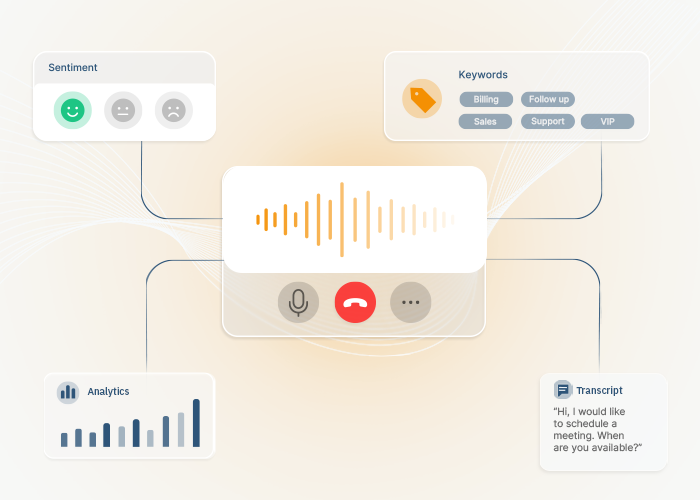
Diagram illustrating how Genesys SIP integration connects cloud telephony, SIP trunking, and business phone systems.

Most businesses assume that if they’re already using Genesys, they’re fully equipped for global voice communication. Surprisingly, that’s not the case. Without the right voice network behind it, your Genesys …Read More »

How Global Enterprises Can Use Webex BYOC to Scale Global Voice

Webex Calling is one of the most capable unified communications platforms an enterprise can run, and the broader UCaaS market it belongs to is projected to reach $404.25 billion by 2033. For large organizations, though, the collaboration layer is only half the equation. The other half is the Public Switched Telephone Network (PSTN) that carries real calls to real customers in every market, and that is where bundled options start to show their limits.

These standard, out-of-the-box carrier bundles typically package:

  • Fixed Minutes: A rigid allotment of domestic (and occasionally international) calling minutes per user.
  • Basic Number Provisioning: A standard Direct Inward Dialing (DID) phone number and basic emergency routing.
  • Standard Features: Basic cloud routing like voicemail-to-email and standard call forwarding.

For a business operating in a handful of countries, Cisco’s native calling plans work well. For a multinational enterprise with offices, customers, and regulatory obligations across dozens of markets, relying on one bundled PSTN source can create gaps in coverage, slow provisioning, documentation hurdles, and uneven number availability.

That is why many enterprises separate the telephony carrier layer from the UC platform through Bring Your Own Carrier (BYOC). In this guide, we’ll cover:

Key Takeaways

  • Large enterprises often separate PSTN from UC platforms
  • Webex remains the collaboration layer
  • BYOC adds flexibility, scale, and global reach
  • Best-fit strategy often combines Webex + specialized global carrier

What Is Webex BYOC?

Webex BYOC (Bring Your Own Carrier) is a flexible telephony solution that lets an organization connect Webex Calling to an external voice carrier instead of buying PSTN service directly from Cisco.

Webex remains as the platform your teams use to call, meet, message, and collaborate, while a separate voice carrier supplies the phone numbers, routing, and in-country connectivity underneath it. The 2 layers work together, but they no longer have to come from the same vendor.

Webex Calling can connect to the phone network (the PSTN) in a few ways. With Cisco Calling Plans, Cisco is your carrier in a bundled package, and Cisco also supports bringing an outside carrier through its certified programs.

There’s also a simpler option that needs none of that setup: Keep your Webex number and forward calls from international numbers you buy elsewhere into Webex. That’s the approach we’ll focus on here, since it’s the easiest way to add global coverage without changing how Webex is set up.

Both CCP and Local Gateway are BYOC paths, and many enterprises use SIP Trunking to route their chosen carrier’s numbers into Webex. Everything stays managed centrally in the Webex Control Hub.

Why BYOC Matters for Enterprise IT Teams

For enterprise IT, BYOC comes down to control. Bundled plans tie coverage, pricing, and number availability to a single vendor’s footprint, so a gap in that footprint becomes your gap too. BYOC lets teams choose the phone carrier that performs best in each region, add markets on their own timeline, and avoid being locked into one provider for everything.

That flexibility also reduces risk. When the carrier layer is separate from the platform, an enterprise can change carriers, add a specialist for hard-to-reach regions, or reroute traffic during an outage without ripping out Webex. The collaboration experience stays consistent for users while IT adjusts the carrier layer underneath.

Why Large Enterprises Decouple PSTN from UC Platforms

As organizations expand internationally, many find it more practical to separate their communications platform from their global voice provider. This lets each solution do what it does best.

  • UC platforms and PSTN solve different problems – Webex and a voice carrier are built for different jobs. Webex handles the calling and collaboration experience — users, devices, softphones, meetings, and messaging. A voice carrier handles phone numbers, call routing, local regulations, and connecting calls around the world. Because these are such different specialties, expecting one company to be great at both usually means settling for less on whichever side isn’t its strength.
  • One vendor rarely excels everywhere – Strong collaboration software may offer PSTN in only a limited set of regions, while a strong global carrier may lack enterprise collaboration tools. Expecting a single provider to lead in both usually means accepting weaker coverage, higher costs, or slower provisioning somewhere in the mix.
  • Multi-country enterprises need room to adapt – Different countries call for different telecom approaches, documentation, and number types, and requirements shift over time. Mergers and acquisitions add fragmented carrier contracts that have to be consolidated, and new markets appear on the roadmap faster than a bundled plan can follow. Keeping the carrier layer separate gives IT the freedom to adapt over time without having to rebuild the phone system.

Common Challenges Enterprises Face with Native PSTN Options

Native calling plans are convenient, and for smaller footprints they are often the right choice. At global scale, though, the same convenience can turn into friction. The challenges below are the ones enterprise teams tend to hit first when they expand Webex Calling across borders.

Limited Country Coverage

Webex Calling supports users in roughly 85 countries across all 3 PSTN options combined, but the bundled Cisco Calling Plans cover far fewer. As of this writing, Cisco Calling Plans are available in about a dozen markets — the United States, Canada, and a set of European countries such as the UK, Germany, and France. Cloud Connected PSTN extends reach to 65+ countries through certified providers, and Local Gateway opens up the rest.

For an enterprise growing into Latin America, the Middle East, Africa, or Southeast Asia, that leaves real gaps. High-growth regions are often exactly the ones bundled plans reach last, so a business expanding there needs another way to obtain local numbers and connectivity.

Strict Documentation Requirements

Many countries require business registration documents, local address proof, or know-your-customer (KYC) records before a number can be activated, and the exact requirements vary market by market.

Navigating those rules across a dozen jurisdictions is a heavy lift for an internal team, and missing paperwork stalls activation. A carrier that manages this documentation as part of provisioning removes a recurring source of delay.

Inconsistent Number Types

Number type availability is uneven under bundled plans. A market might offer local numbers but no toll-free option, and toll-free coverage in particular tends to be limited to select markets.

Cisco Calling Plans, for example, have historically offered toll-free numbers only in a small number of regions. Enterprises that rely on toll-free access for customer support, or that want a single Universal International Freephone Number (UIFN) across regions, often find bundled coverage doesn’t line up with where their customers are.

Global cloud telephony carriers can often fill those gaps with more flexible options (like callback or Toll-Free FlexDial) so you stay reachable even where a standard number isn’t available.

Why Enterprises Choose Webex BYOC

BYOC is how enterprises add international coverage to Webex Calling without giving up the experience users rely on. It solves the coverage and control problems bundled plans can’t, and 5 benefits come up most often when enterprise teams make the switch.

1. Broader Global Number Access

A specialized carrier can supply local, mobile, toll-free, and UIFN numbers in far more markets than a bundled plan reaches. For example, Global Call Forwarding can provide reliable voice coverage in 160+ countries where an enterprise may need presence. That covers the high-growth and hard-to-reach regions where bundled coverage runs thin, so IT can source every number type from one carrier partner.

2. Faster Market Expansion

With a carrier that provisions numbers as a core service, adding a country becomes a configuration step rather than a project. Provisioning still depends on local rules and regulations and typically takes a few business days per market, but a partner that handles registration and documentation keeps launches on schedule. That helps a business move into a new market more quickly.

3. Better Cost Management

Separating the carrier layer gives IT room to manage voice spend deliberately. Enterprises can choose cost-effective routes market by market, consolidate fragmented contracts left over from acquisitions, and negotiate rather than accept bundled pricing everywhere. Over a large footprint, controlling per-region costs adds up to meaningful savings.

4. Greater Resilience and Reliability

Voice quality and uptime depend on the carrier’s network, not the collaboration platform. A carrier with a redundant global network — geo-redundant Points of Presence, direct carrier routes, long-term carrier relationships, and automatic failover — keeps calls connecting even when a route or region has trouble. Because the carrier layer is independent, an enterprise can also reroute traffic or add a backup provider without disturbing Webex.

5. Long-Term Stability

BYOC gives enterprises a communications setup that adapts as the business changes. New markets, acquisitions, and shifting regulations no longer force a platform migration, because the voice side can adapt underneath a stable Webex setup. Keeping the two separate means your teams keep using Webex the way they like, while you stay free to adjust your global voice setup as needs change.

What Global Webex Calling Looks Like with BYOC

In practice, a BYOC deployment keeps Webex at the center and adds a carrier partner to handle numbers and global connectivity. The sections below show a common deployment model, the regions BYOC opens up, and the use cases where it delivers the most value.

Example Deployment Model

Here’s what a Webex setup looks like when you add Global Call Forwarding for international numbers. Webex stays the platform your teams use every day, while we handle the numbers and connectivity behind the scenes:

  1. Webex Calling handles users and collaboration – Teams keep the softphones, devices, meetings, and messaging they already use, with no change to the day-to-day experience.
  2. The carrier provides the numbers – Global Call Forwarding supplies local, mobile, and toll-free numbers in each target market and activates them once the required documentation is in place.
  3. Calls route into Webex – You order a DID number in the Webex Control Hub, then set your Global Call Forwarding number to forward calls to it. Calls to your local or toll-free number ring straight through to Webex Calling.
  4. Everything is managed centrally – Users and calling policies stay in the Webex Control Hub, while numbers, routing, and reporting live in the carrier platform, giving IT one clear place for each layer.
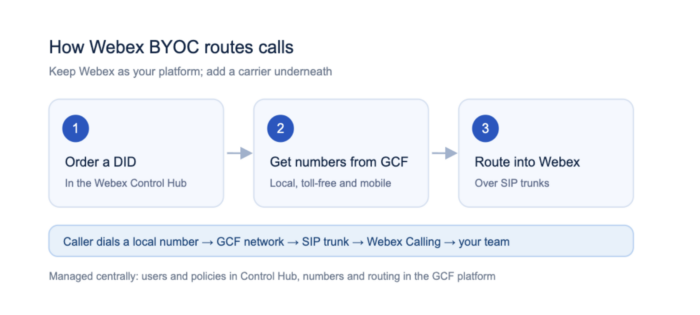
Infographic of how Webex BYOC routes calls

Regions Commonly Supported via BYOC

BYOC is most valuable in the regions bundled plans reach last. A specialized carrier can extend global Webex calling into markets across:

  • Latin America — including Brazil, Mexico, and Colombia, where local presence drives trust.
  • Middle East — where documentation and in-country rules make bundled provisioning slow.
  • Africa — where toll-free and local coverage is often thin under native plans.
  • Asia-Pacific — where a mix of local, national, and toll-free numbers is needed across many markets.

Use Cases

Webex BYOC earns its place in specific situations rather than every deployment. The 4 scenarios below show where enterprise teams put it to work most often.

A) Global customer support rollouts. A company building out support in new regions can buy local and toll-free numbers in each country and forward them into its central Webex teams. Customers dial a familiar local phone number, and the call rings through to the right agents in Webex.

B) Regional sales presence. In-country numbers give sales teams a local presence that improves trust and pickup rates in each market. With BYOC, an enterprise can present a local number in every region while its reps continue working inside Webex.

C) M&A telecom consolidation. Acquisitions often leave a business with a patchwork of carrier contracts across countries. BYOC lets the combined organization keep Webex as the standard platform while consolidating fragmented carriers under one partner, simplifying billing and management.

D) Global business continuity. Because your numbers and carrier sit outside Webex, you can build in backup routes across regions. If a route or region has trouble, calls reroute through the carrier’s global network, keeping your international lines available.

How Global Call Forwarding Supports Enterprise Webex BYOC Strategies

Webex gives enterprises a strong collaboration foundation, and a specialized carrier is what turns it into dependable global voice. When evaluating a carrier partner for a Webex BYOC deployment, enterprise teams should look for a few essentials: coverage across multiple countries including hard-to-reach markets, compliance and documentation expertise, faster provisioning, flexible routing, and responsive 24/7 support.

It helps to do a little homework here: do comparative research, read customer reviews and testimonials and ask the provider’s sales team direct questions about coverage, provisioning timelines, and how they handle outages.

Global Call Forwarding was built for exactly this role. We provide access to 18,000+ local, mobile, and international toll-free numbers across 160+ countries — including the underserved regions across Africa, the Middle East, Southeast Asia, and Latin America that bundled plans reach last. Our team provisions and activates those numbers with the local documentation handled for you, backed by a highly redundant network with Tier-1 voice routes and global Points of Presence.

Adding us to your Webex setup is simple and doesn’t disrupt anything. You buy the international numbers you need from Global Call Forwarding and forward them into your Webex Calling environment, so your teams keep the interface they already know while you extend reach market by market.

And because we handle local telecom compliance, you don’t have to navigate country-by-country rules on your own.

Advanced features come along with our virtual phone numbers, too! Included Custom Reports for call analytics, plus Call Recording, IVR, and intelligent call routing. For deeper insight, AI Call Insights is available as a premium add-on.

And 24/7 US-based support means help is a real person, not a ticket queue. Learn how to add our cloud phone services and forward calls to Webex.

Need International Phone Numbers for Your Webex Deployment?

Our telecom specialists can help you identify the right local, toll-free, or mobile numbers, configure routing to your Webex DID, and build a scalable global voice strategy.

Our telecom experts at Global Call Forwarding can help you map the right numbers, routing, and coverage for your global deployment.
Call us at +1 (561) 908-6171 or chat with us online.
Customer Support in the GCC: Ensuring Reliable Support with Cloud Telephony

The Gulf Cooperation Council (GCC) is one of the fastest-digitizing regions in the world. The World Bank reports that GCC economies are accelerating their digital transformation as they diversify beyond oil, and the region’s digital economy is expanding at double-digit rates year over year. Customers in the UAE, Saudi Arabia, Qatar, and across the Gulf now expect fast, personalized, always-available service to match that pace.

Voice still carries the moments that matter most. When an issue is urgent or sensitive, customers reach for a phone call, and they want to reach a number that feels local and someone who answers in their time zone. Cloud telephony makes that possible without hardware in every country.

In this article, we’ll cover why customer support in the GCC calls for a different approach, what cloud telephony does for support teams, the features that keep service reliable, practical use cases, and how businesses use Global Call Forwarding across the region.

Key Takeaways

  • Customer support in the GCC works best with local and toll-free numbers that customers recognize and trust, backed by routing that respects Gulf time zones and languages.
  • Cloud telephony delivers this without in-country offices or hardware — your provider activates the numbers and runs the network, and your team manages call flows from one control panel.
  • The features that matter most are local and toll-free coverage, multi-region routing, multilingual IVR, Local 2-Way Voice, call analytics, and CRM and help desk integrations.
  • Global Call Forwarding provides compliant, carrier-grade coverage across GCC markets, with 24/7 support and 30 years of experience serving the region.

Why Customer Support in the GCC Requires a Different Approach

The GCC region constitutes high service expectations, a multilingual customer base, and complex country-by-country telecom rules. So a support setup built for one country tends to leave gaps when customers start calling from six, and the gaps become more visible when communicating from outside the region.

Unique Challenges in GCC Markets

A few challenges and obstacles come up again and again for teams supporting the region. Understanding these early shapes a cleaner global support setup:

  • Trust in local access: Customers hesitate to call an unfamiliar foreign number or pay international rates to reach a business in the Middle East. A recognizable in-country local number lowers that barrier and lifts the rate at which calls get answered.
  • A multilingual, multinational customer base: GCC markets serve Arabic-speaking nationals alongside large expatriate communities, so callers expect service in Arabic and English, and often other languages. A single-language phone menu turns customers away before they reach an agent.
  • Distance and time zones: Many companies serving the Gulf run their support teams elsewhere. Without routing that follows Gulf Standard Time, after-hours calls go unanswered and response times slip.
  • Country-specific telecom rules: Number availability, documentation, international routing, and caller ID requirements differ across the UAE, Saudi Arabia, Qatar, and neighboring markets. What works in one country may not be permitted in another.
  • Fragmented providers: Piecing together a separate carrier in each country creates inconsistent quality, multiple invoices, and more points of failure; a hard base to build dependable support on.

What Cloud Telephony Can Do for Support Teams

Cloud telephony hosts your business phone numbers, call routing, and features in the cloud rather than on hardware in each office. Your provider activates the numbers and runs the underlying network, while your team manages call flows through an online control panel from anywhere.

Cloud telephony gives support teams a way to clear those hurdles from one platform. Let’s break down what that looks like in practice, from day-to-day flexibility to managing inbound and outbound calls across borders.

Enable Flexible and Reliable Conversations

Because everything lives in the cloud, your support team can take and place calls from a softphone, desktop dialer, or IP phone anywhere with a stable connection. Agents in Dubai, a support hub in another country, and remote staff can all work from the same account, which suits the distributed teams that commonly serve the Gulf.

Reliability comes from the global voice network underneath. A provider with geo-redundant Points of Presence (PoPs) and Tier-1 carrier routes keeps call quality high and reroutes traffic automatically if a single route or region has trouble. Global Call Forwarding runs this kind of carrier-grade network designed for 99.999% uptime, so support lines stay available as call volume rises. Adding a new GCC market becomes a configuration change rather than a hardware project, which keeps the setup quick to launch and simple to scale.

Manage Global Calls Efficiently

Cloud telephony brings inbound and outbound support under one roof. On the inbound side, your provider activates local, national, and toll-free numbers in the markets you serve, then you route each call by region, time of day, and skill so it reaches the right agent. IVR menus, failover routing, voicemail-to-email, and overflow rules make sure calls are captured even outside business hours.

Outbound support runs from the same platform. When agents return calls or follow up with GCC customers, an Outbound Calling plan paired with Local 2-Way Voice lets them place calls that display a local caller ID, so follow-ups look consistent with the number customers first dialed. Managing both directions in one control panel gives your team a single, coordinated view of every conversation instead of separate systems per country.

Key Features to Offer Reliable Customer Support in the GCC Region

A dependable GCC support operation rests on a handful of capabilities working together. The features below are the ones that most affect whether customers reach you, trust you, and get resolved quickly.

Local and Toll-Free Numbers in GCC Markets

Number coverage is the foundation of Gulf support. Global Call Forwarding offers Middle East virtual phone numbers across GCC markets including the UAE, Saudi Arabia, and Qatar, with the exact number types available varying by country. In the UAE, for example, you can choose toll-free, national, or local numbers on the +971 country code.

Each type serves a different purpose for support. Toll-free numbers let customers call at no cost, which encourages people to reach out with questions. Local and national numbers give your business a familiar in-country presence, so callers recognize the number and are more likely to answer when you call back. Because your provider handles activation and the required documentation, you get an in-country presence without opening an office there.

Number Type What it is Best for Support Teams
Toll-Free A free-to-call number on a national toll-free prefix Encouraging inbound support calls at no cost to the customer
National A single country-wide number, reachable inside and outside the country A consistent national point of contact across a GCC market
Local A number tied to a city with a specific area code A recognizable local presence in hubs like Dubai or Abu Dhabi

Multi-Region Routing and Multilingual IVR

Once your numbers are live, routing decides where each call goes. Custom call flows send calls by country, time of day, and agent skill, so a caller from Riyadh reaches a different queue than one from Doha, and after-hours calls follow the sun to a team that’s awake. A multilingual IVR greets callers in their own language and lets them self-select a department or agent before anyone picks up. Serving customers in their own language builds loyalty. CSA Research found that 75% of consumers are more likely to buy from a brand again when support is in their language.

For example, a software company outside the region might set up support for the Gulf like this: a caller dials the company’s UAE number, hears an Arabic and English greeting, presses 1 for billing or 2 for technical help, and is routed to an Arabic-speaking agent during Gulf business hours or to a global team overnight. The whole flow is built once in the control panel and adjusted as demand shifts, using IVR menus and routing rules.

Local 2-Way Calling

When agents follow up with GCC customers, Local 2-Way Voice lets them place outbound calls that show the same local number customers already know, which makes callbacks more likely to be answered and keeps your presence consistent.

Displaying a local caller ID in the Gulf comes with rules that differ by country. Caller ID presentation, number registration, and call recording consent are governed by regulators such as the UAE’s TDRA and Saudi Arabia’s CST, and regulatory requirements change over time. Because these rules vary market by market, it helps to work with a global telephony provider that manages the documentation and compliant routing for you. For more context, see Global Call Forwarding’s guidance on telecom compliance when planning global support.

Analytics and Quality Call Monitoring

You can’t improve support you can’t see. Understanding who’s calling, when they call, and what they’re calling about tells you where to staff, which markets are growing, and where customers get stuck. Call analytics turn day-to-day activity into decisions instead of guesswork.

With Global Call Forwarding, you can track regional call activity through Custom Reports, a free and included feature that breaks down volume, answer rates, and call patterns by number and region. For deeper analysis, AI Call Insights reads call transcripts to surface themes, intent, and sentiment across your GCC lines, so you can spot recurring issues and coach agents with real examples. Together they give leaders and managers one view of support performance across every Gulf market.

Integration with Business Apps

Support moves faster when voice connects to the tools your team already uses. Linking calls to a CRM or help desk means every conversation is attached to a ticket and contact record, agents see caller information the moment a call lands, and nothing gets logged twice. That shared context keeps service consistent across regions and shifts.

Global Call Forwarding offers CRM and help desk integrations with platforms like Salesforce, HubSpot, Zoho, and Zendesk, plus BYOC solutions to bring your international phone numbers into systems such as Microsoft Teams and Genesys. That flexibility lets your GCC voice layer fit your existing stack instead of replacing it.

Use-Case Examples for Support Teams in the GCC

The features above come together differently depending on the business. Here are 4 illustrative scenarios showing how teams commonly structure GCC support with cloud telephony.

1. Global E-Commerce Brand Serving the Gulf

A global online retailer sells into the UAE, Saudi Arabia, and Qatar and wants shoppers to reach support easily in each market. The brand sets up local numbers in all 3 countries and routes calls to a regional support team, with an Arabic and English IVR at the front. Each call syncs to the company’s CRM, so agents see order history the moment a customer calls. Shoppers reach a familiar local number, and the brand runs one connected support operation across 3 GCC markets instead of 3 separate ones.

2. SaaS Vendor With Global Support Teams

A software vendor supports customers worldwide from teams in the Americas, Europe, and Asia. To serve Gulf clients, it adds GCC numbers so customers see a local point of contact, then routes calls to whichever regional team is on shift. Time-based routing sends daytime GCC calls to nearby agents and overnight calls to another continent, giving customers a local number and round-the-clock coverage without a physical office in the region.

Related: GITEX 2025 Trends & Conversations

3. Logistics and Field-Services Company in the Gulf

A logistics and field-services company operating across the GCC needs support available at all hours for time-sensitive requests. They use a cloud phone system with an IVR that lets callers choose dispatch, tracking, or account help, then routes each call to the right on-call team. Failover and overflow rules make sure urgent calls are always picked up, so the company delivers dependable 24/7 support across Gulf states from one coordinated setup.

4. Pilot in One Market, Then Scale Across the Region

A company testing the Gulf starts with a single UAE number and a small support team to gauge demand. As call volume grows, it adds numbers in Saudi Arabia and Qatar, layers in multilingual routing, and connects the lines to its help desk. Because everything runs on one cloud platform, expanding is a configuration change rather than a new vendor contract, so the business scales support at the pace the market sets.

How Businesses Use Global Call Forwarding Within the GCC Region

The scenarios above play out with real companies and real feedback. Below are a couple of businesses that use Global Call Forwarding to support customers across the Gulf, followed by what customers say about the service.

ScienceSoft — IT and Software

ScienceSoft, a US-based software company serving clients in the Gulf, needed to win and support business locally while keeping its marketing and sales team centralized outside the UAE. Global Call Forwarding provided a UAE National Number that gives Gulf customers a familiar in-country number to call, with calls forwarded reliably to the central team. The result is local trust and accessibility in the UAE without decentralizing operations, backed by support that reaches even hard-to-serve markets.

Crystal Cruises — Travel and Hospitality

Crystal Cruises, a luxury cruise line, wanted to give Middle East customers timely, high-end assistance despite serving them from different time zones. Using local numbers that connect to a regional contact center, the company gives callers a number that feels local and reaches support when it’s daytime where they are. The setup has helped Crystal Cruises improve customer satisfaction and reduce lost sales across the region.

Additional Customer Feedback

A telecommunications leader in the Middle East summed up the experience in a letter of recommendation:

“I wanted to take a moment to express my sincerest gratitude for the exceptional global telephony service I received from you and your team. From the moment I first reached out to your company, I was impressed by the professionalism and attentiveness of your staff.” — Derek F., Vice President, Telecommunications, Middle East

Another customer who runs support across borders highlighted the reliability and compliance that matter most in the region:

“Every time I’ve needed support, help or service they’re available within moments by chat or phone, no problem. The services have been great from three different continents forwarding calls to the US. It’s a complicated compliance environment moving between countries, but GCF makes it look easy.” — Art D.

That combination of always-available support and compliant cross-border routing is what dependable GCC customer support runs on. It’s also what keeps calls flowing when a business operates across several Gulf markets at once.

Read more reviews and testimonials.

Why Choose Global Call Forwarding for GCC Support?

A few strengths make Global Call Forwarding a strong fit for supporting customers across the Gulf:

  • Global coverage with GCC depth: Numbers in 160+ countries, including toll-free, national, and local coverage across GCC markets like the UAE, Saudi Arabia, and Qatar.
  • High-quality cross-border routing: Quality-first routing over Tier-1 carriers keeps calls clear as they move between the Gulf and your teams elsewhere.
  • Reliability and network strength: Geo-redundant PoPs and failover designed for 99.999% uptime keep support lines available as volume grows.
  • Regional and compliance expertise: A team that manages number registration, documentation, and compliant routing across GCC markets so you don’t have to track every rule yourself. Having served major regional companies and exhibited at GITEX Global multiple times, we have a good understanding of local needs and demands.
  • Integrations and analytics: CRM and help desk integrations, Custom Reports, and AI Call Insights connect your voice channel to the rest of your support stack.

Behind all of this sits 24/7 human support, dedicated account managers, and 30 years of experience serving international businesses, including a long-standing presence across the Middle East and Africa.

Build Your GCC Support Strategy With Global Call Forwarding

Reliable customer support in the GCC comes down to reaching customers on numbers they trust, routing calls intelligently across languages and time zones, and running it all on a network built to stay up. Cloud telephony brings those pieces together on one platform, and the right provider handles the coverage, compliance, and reliability underneath.

Ready to map out support for the Gulf? Our MEA team at Global Call Forwarding can help you plan the right numbers, routing, and coverage for your GCC markets and connect them to your existing customer support tools. Call us at +1 (561) 908-6171 or chat with us online.

6 Months in Brazil: What We’ve Learned While Building Our São Paulo Hub

Six months ago, Global Call Forwarding officially opened its Brazil office. At the time, the goal was clear but focused: build a strong foundation for IT and AI-driven development while expanding our global footprint.

Fast forward six months, and that initial plan has grown quickly and organically into something much bigger.

What started as a targeted technical investment has evolved into a multi-function hub supporting marketing, customer support, and operational visibility across regions. Along the way, we’ve expanded our office space multiple times, built a strong local culture, and learned valuable lessons about scaling teams with intention.

From an IT Focus to a Multi-Function Hub

When we first opened the Brazil office, our primary objective was to strengthen our IT and AI development capabilities. Brazil’s technical talent pool, combined with its growing role in global SaaS and telecom ecosystems, made it a natural fit.

What we didn’t fully anticipate was how quickly the scope would expand.

Within months, it became clear that the local talent market extended far beyond technical roles. We were able to successfully hire for marketing and customer support positions, bringing in professionals who not only had the right skills, but also a deep understanding of global customer needs.

This shift wasn’t part of the original blueprint, but it reinforced something we value at Global Call Forwarding: staying flexible and letting strong opportunities guide growth.

“São Paulo’s tech ecosystem is incredibly vibrant. While we initially arrived to build a development team, the talent and versatility on the ground quickly turned our Brazil hub into a vital extension of our global operations, supporting roles from IT and marketing to customer-facing roles.” – Luke Genoyer, Business Development Manager, Global Call Forwarding.

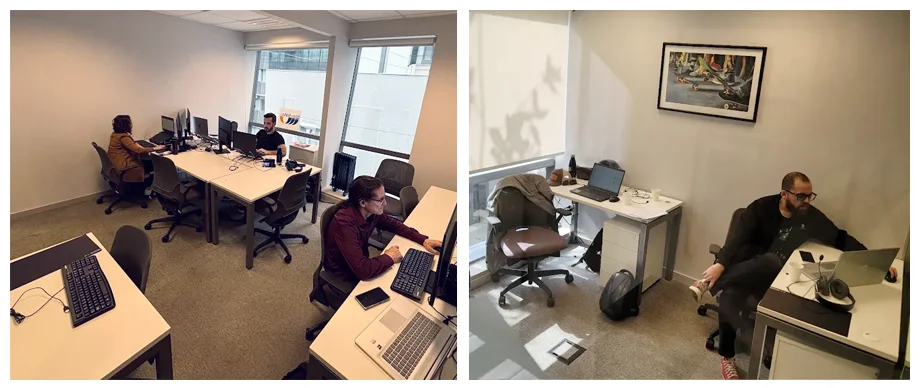
Global Call Forwarding team members working at modern workstations within the São Paulo office hub.

Scaling Faster Than Expected

Growth in Brazil wasn’t just reflected in headcount; it showed up very quickly in our physical space. In just six months, the office has already been upgraded three times to accommodate a growing team (about 130% growth). Each expansion reflected a deliberate decision to invest early in an environment that supports collaboration, focus, and long-term growth—not just short-term capacity.

This rapid expansion reinforced a key lesson: when growth is happening, infrastructure needs to keep pace. Waiting too long to adapt space or systems creates friction, and moving early creates momentum.

The Talent Advantage in Brazil

One of the most consistent takeaways from the past six months has been the strength of the local talent pool. Brazil offers a rare combination of technical expertise, creativity, and energy. Across IT, marketing, and customer support, we’ve seen high engagement levels, fast learning curves, and a strong sense of ownership.

Equally important, the reliability of local infrastructure and connectivity has allowed teams to support global operations seamlessly. This is critical in a telecom environment where uptime and responsiveness matter.

This talent advantage has reinforced Brazil’s role as a long-term strategic location, not just a satellite office.

Visual Management and Real-Time Indicators

As the Brazil office grew, so did its role in monitoring and supporting operational performance across teams.

One of the most impactful changes has been the introduction of visual management—using real-time indicators and dashboards to keep critical metrics visible and accessible. These include:

  • Service availability and uptime
  • Call routing and traffic indicators
  • Marketing performance signals
  • Operational health checks

Rather than burying performance data in reports, visual management makes it easy for teams to see what’s working, what needs attention, and where action is required, without delay. This approach has strengthened accountability and alignment while enabling faster decision-making across teams.

Building Culture, Not Copying It

While alignment with global values matters, we’ve been intentional about allowing the Brazil office to develop its own culture. The team has shaped something that feels local, authentic, and inclusive. From holiday celebrations to team-led initiatives, culture here has been built through shared experiences, not policies.

Over the past few months, that’s included:

  • Team celebrations and dinners
  • A local holiday toy drive
  • Office-led initiatives around connection and engagement

These moments matter. They build trust, strengthen collaboration, and create an environment where people want to grow—not just work.

“Helping build this office from the ground up has been an incredible experience. Because our culture is driven by the team rather than just policy, there’s a deep level of trust, engagement, and friendship. You can really feel that everyone is personally invested in making this a place where we don’t just work, but truly grow together.” — Luiz Santana, Customer Success Manager, Brazil Office.

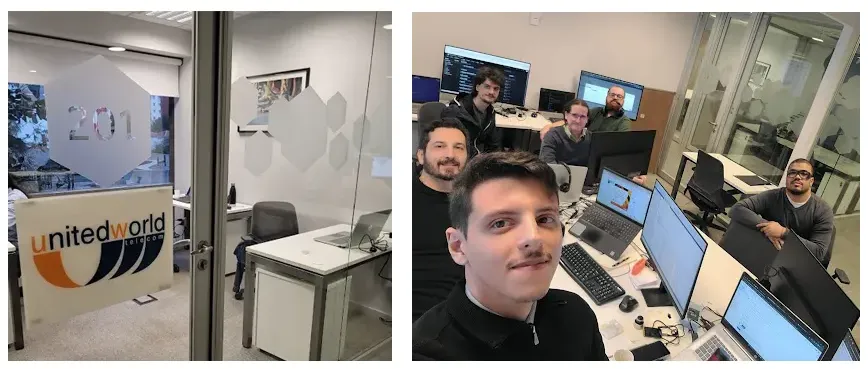
Global Call Forwarding team members working and collaborating in their modern São Paulo office hub.

A Long-Term Investment, Already Paying Off

Six months in, the Brazil office has already become an integral part of Global Call Forwarding’s global operations. And this is just the beginning.

The focus for the next phase includes continued hiring, deeper integration with global teams, and expanding the scope of responsibilities supported from São Paulo. Most importantly, we’ll continue investing in people, systems, and culture—at the same pace as growth.

Opening our Brazil office wasn’t about short-term expansion. It was a long-term investment in talent, resilience, and operational excellence.

Six months in, the results are already visible—in our teams, our systems, and our culture. As we continue to grow globally, Brazil is playing an increasingly important role in shaping how we build, support, and scale at Global Call Forwarding.

GITEX 2025: Trends & Conversations Shaping MEA Communications

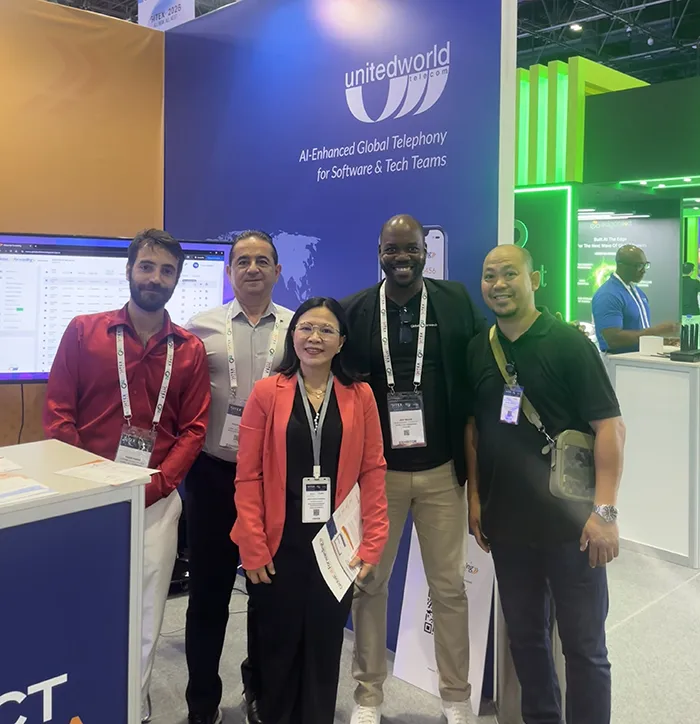
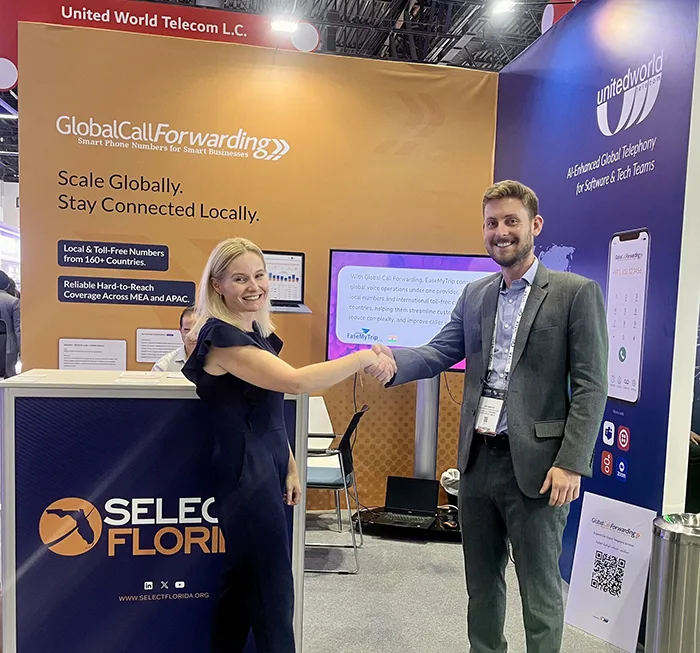
Another incredible year exhibiting at GITEX has just come to a close in Dubai.

As a long-time attendee, it was clear this year’s event marked a significant acceleration in the region’s digital growth. From conversations on connectivity and infrastructure to witnessing firsthand the implementations, this year’s event reminded me how quickly the Middle East is progressing along its tech journey.

At our booth, we met dozens of industry leaders from around the world, each with a sharp eye on how global business communications must evolve.

The conversations made one thing clear: as companies in the Middle East and Africa evolve at a faster pace than ever, having reliable, flexible, and locally adapted communication systems becomes increasingly important.

For us at Global Call Forwarding, this year’s presence reinforced our long-term investment in the region’s ecosystem: being on the ground, listening to pain points, and helping companies unlock voice and telephony solutions that match their dynamic pace.

Seeing the market evolve allows us to transform insights into technologies that give our customers a competitive edge.

In this post, I’ll share:

Top Voice & Telecom Trends from GITEX 2025

Voice and telephony aren’t just auxiliary services; they’re core to business continuity.

1. Telecom Infrastructure Modernisation with Enterprise Voice in Mind

At GITEX 2025, major ICT players highlighted how next-generation connectivity (AI-native cloud, 5G/5.5G, edge) is shifting from consumer-buzz to enterprise form-factor.

For example, Huawei showcased its AI-native cloud and intelligent network solutions in the region, designed to manage traffic intelligently, reduce energy consumption, and optimize capacity planning in real-time.

What this means for enterprise telephony: Businesses firms expanding across MEA require voice platforms built on a network that is not only robust but also tuned for low latency, cross-border reach, advanced routing, and regulatory compliance.

2. The “Local Everywhere” Model is Now Standard

Prospects emphasized the need for reliable localized phone numbers, whether for back-office support or to demonstrate local presence. We have heard repeatedly about displaying local phone numbers on business cards or localized websites, even though the routing may be global.

This is driving significant demand for solutions like Local 2-Way Voice for DID numbers and international toll-free numbers. This regional insight, along with the continued popularity of toll-free numbers for accessible support, proves that building trust starts with being reachable.

What this means for enterprise telephony: Voice and telephony platforms must deliver local numbers (UAE, KSA, South Africa), toll-free options in the region, and global routing—all under one centralized platform, enabling enterprise control and scale.

3. Integrated & Unified Global Voice Infrastructure

Across meetings and demos, another recurring theme was that traditional PBXs and native UC tools—like Microsoft Teams or Genesys Cloud—are limited in their global coverage in the Middle East and Africa. Many companies told us they rely on these systems for their core phone systems, but struggle when:

  • They need local inbound numbers in multiple MEA countries.
  • Their provider doesn’t support outbound caller ID or compliant routing for specific markets.
  • Global sales and support teams must route calls across regions while maintaining unified analytics and CRM data.
  • They need apps on different platforms or devices for flexible communication.

What this means for enterprise telephony: These gaps are why voice integrations and SIP connectivity are now top of mind for IT decision-makers. Instead of replacing their PBX or UC stack, enterprises are looking to extend it. This means integrating external carriers through BYOC solutions to bridge coverage gaps and improve resilience.

Likewise, CRM integrations with platforms like Salesforce and HubSpot are no longer a nice-to-have but a necessity for creating a unified view of the customer.

For companies expanding in MEA, the future of voice isn’t another standalone app, it’s an ecosystem. One where existing PBX, UC, CRM, and help desk systems connect with global, AI-powered telephony infrastructure that extends reach, compliance, and intelligence far beyond what any single platform can deliver.

4. Regulatory Complexity and “Hard-to-Reach” Market Voice Accessibility

Although GITEX’s public coverage emphasises AI, cloud and data infrastructure, telecom-industry sources at the show highlighted that MEA remains a region where voice infrastructure still has friction: regulatory fragmentation, inbound and outbound routing challenges, compliance requirements, lack of phone numbers in hard-to-reach countries, etc.

For example, Libya doesn’t offer traditional phone numbers or call forwarding numbers, making it difficult for businesses outside the country to expand within the region. A solution like Toll-Free FlexDial helps bypass these issues, providing accessible and flexible voice support.

Additionally, the spotlight was on secure cloud solutions and compliance-ready infrastructure. For businesses expanding across the MEA, this concern extends directly to their communication channels, which handle sensitive customer data. The conversations moved beyond general network security to the specifics of protecting voice data.

What this means for enterprise telephony: Businesses expanding in MEA are asking: “Can I launch a UAE local number quickly? Is my outbound routing compliant with KSA rules? Will calls from Libya or Africa reach me reliably?” This is where the importance of a compliant, Tier-1 carrier-grade network becomes critical. Businesses need assurance that their calls are secure, reliable, and compliant with regional telecom regulations.

5. Intelligent Voice and Communications Layer

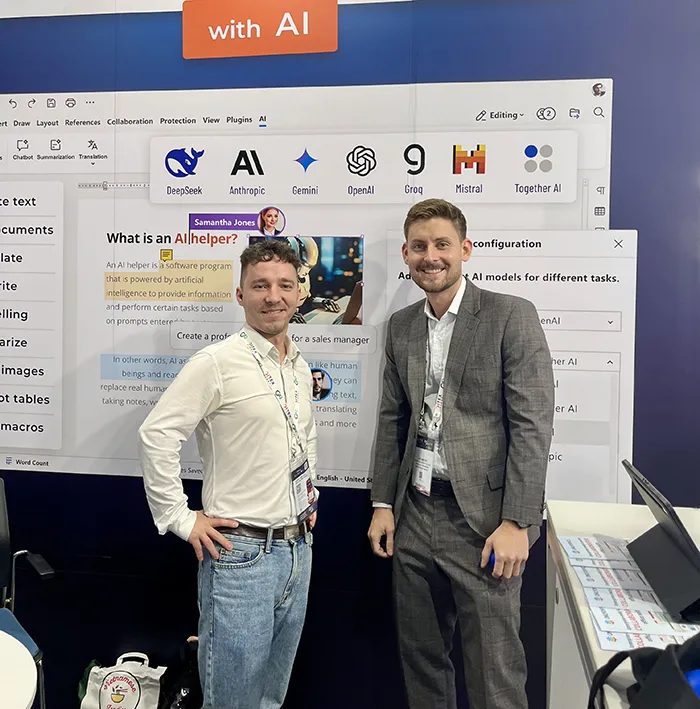
AI was everywhere at GITEX, but the focus has shifted from theoretical possibilities to practical B2B applications. Instead of futuristic concepts, leaders were discussing how AI is helping automate repetitive work, extract insights from data, and deliver personalized customer experiences.

We spoke with several companies exploring AI voice agents and bots for Level 1 support (forwarding calls to a bot), freeing up human agents for more complex issues. This isn’t just about replacing IVR menus; it’s about creating natural, conversational experiences that resolve customer issues instantly.

The enterprise voice angle is that voice is now expected to be smart, encompassing transcription, sentiment & intent detection, auto-routing, and integration with CRM/UC platforms.

What this means for enterprise telephony: This move toward intelligent voice engagement highlights the growing need for platforms that can not only route calls but also provide the data to power these systems. It’s why features like our AI Call Insights are becoming critical, as they allow businesses to analyze call transcripts and sentiment to improve service and efficiency.

Supporting the Future of Tech in MEA

The MEA region is rapidly evolving into the next frontier of digital innovation, but for many businesses, communication infrastructure still lags behind their growth ambitions.

In our conversations and booth sessions at GITEX, several patterns emerged about how fast-growing companies are deploying voice infrastructure in MEA. Here’s how we help:

Common Voice Challenges in the Middle East

We repeatedly heard these pain points:

  • Friction persists due to fragmented number procurement and unreliable call routing or termination.
  • Many providers maintain separate providers per country or don’t cover MEA comprehensively, leading to a lack of a unified global voice platform.

This is where Global Call Forwarding steps in. We provide the strategic solutions needed to bypass these hurdles:

Challenge Our Solution Value
Local Presence & Trust Local 2-Way Voice, DIDs, Toll-Free Numbers in the UAE, KSA, South Africa, and beyond. Builds customer trust; higher pickup rates; localizes business cards/websites.
Operational Efficiency Global call forwarding and advanced routing, managed easily through an online control panel. Centralizes global sales and GCC support while providing a local contact point for customers.
Flexible Telephony Integrations CRM & Help Desk integrations (Salesforce, Zoho, HubSpot) and BYOC Solutions (MS Teams, Zoom Phone, Genesys) Provides compliant local numbers where major PBX providers cannot and integrates with major business apps.

How Global Businesses Connect with MEA Customers

The path to success in the MEA region requires a seamless, local communication channel. We act as the single provider that makes this possible, as seen in these customer successes:

Ease My TripEaseMyTrip, with offices across six countries, needed a single one-stop provider for its global telephony services. We delivered reliable international toll-free numbers and geographic numbers in desired locations, enhancing accessibility and maintaining their customer-centric reputation.


ScienceSoft logo ScienceSoft, a US-based company serving Gulf clients, needed to generate sales locally while forwarding calls to their centralized marketing team outside the UAE. We offered a UAE National Number to build local trust and guarantee excellent, flexible call forwarding for local clients, as our global presence and reliable support are available even in hard-to-reach countries.


crystal cruises Crystal Cruises uses local numbers that connect to a regional contact center to provide timely, high-end assistance to customers across different time zones, improving customer satisfaction and minimizing lost sales.


Mace Macro stopped by the booth
Mace Macro, a construction consulting firm, uses our international toll-free numbers to secure international coverage and provide seamless back-office support for its global operations, ensuring clients can always reach the right expert.

Tevalis ME manages its Middle East and ANZ operations from the UK. They rely on our international toll-free numbers to forward calls directly to their UK headquarters, maintaining a local presence while centralizing their support team.
meeting with Tevalis

Luke checking in at the OnlyOffice booth
OnlyOffice uses our outbound calling service through our GCF softphone app on both desktop and mobile. With features like custom caller ID and our Click-to-Dial Chrome extension, their APAC sales manager can now call APAC and Middle East prospects using a local phone number.

SoftTeco streamlines its Level 1 tech support by using a UAE number that forwards directly to a sophisticated Voice AI bot, allowing them to provide instant assistance for basic inquiries.

We’re Building for What’s Next

Global Call Forwarding is your dedicated voice partner for the rapidly developing Middle East region. We provide compliant, Tier-1 carrier-grade Middle East virtual phone numbers in over 160 countries.

With over 40 telephony features, including international call forwarding, AI call insights, outbound calling, integrations, custom reports, and more, users can manage global voice efficiently under one unified platform.

For companies scaling in MEA, the next generation of voice infrastructure matters. Our tech and software phone solutions are designed to improve operational efficiency and global coverage.

Our roadmap focuses on:

  • Unifying fragmented voice infrastructure through flexible integrations and BYOC solutions
  • AI Call Insights for advanced analytics and reporting and additional AI layers for smarter communications
  • Regional routing reliability and built-in compliance architecture — so you can operate in Gulf Standard Time, reach callers locally with global scale, and avoid regulatory or carrier blind-spots.

In short, we’re positioning ourselves as the dedicated voice partner for enterprises expanding across MEA. We’re not just enabling calls today, but powering the voice-enabled business of tomorrow.

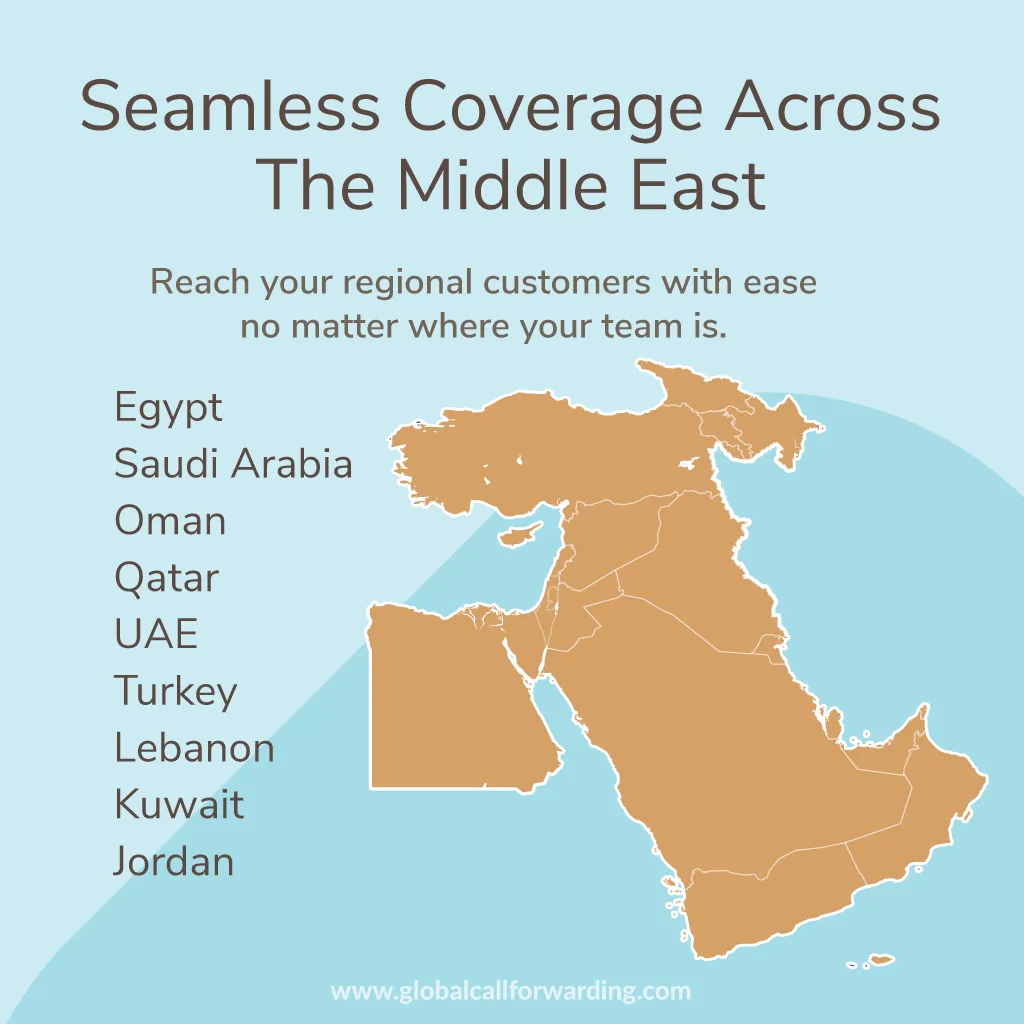
MEA region coverage

Connect with our MEA Experts

Walking away from GITEX GLOBAL 2025, the clear takeaway is this: tech adoption in MEA is real, accelerated, and expanding. But growth isn’t assured unless the communication infrastructure keeps up. For enterprises, a global telephony platform that is local in presence, global in scale, smart in functionality, and compliant in its delivery becomes a strategic enabler, not just a cost centre.

If your organisation is scaling across the Middle East and Africa and reviewing how to build or upgrade its voice infrastructure, let’s explore how Global Call Forwarding can be your voice partner.

We bring regional expertise, global reach, and enterprise-grade telephony capabilities that help you connect, scale, and thrive across this transformational region. Connect with our local experts today or chat with us online!